Since publishing our February snapshot, we’ve continued tracking how EU Digital Identity Wallet projects are evolving across Europe.
In this post, we highlight key updates, reflecting what’s changed over the past few weeks.
Snapshot: EUDIW Member State Implementation Status
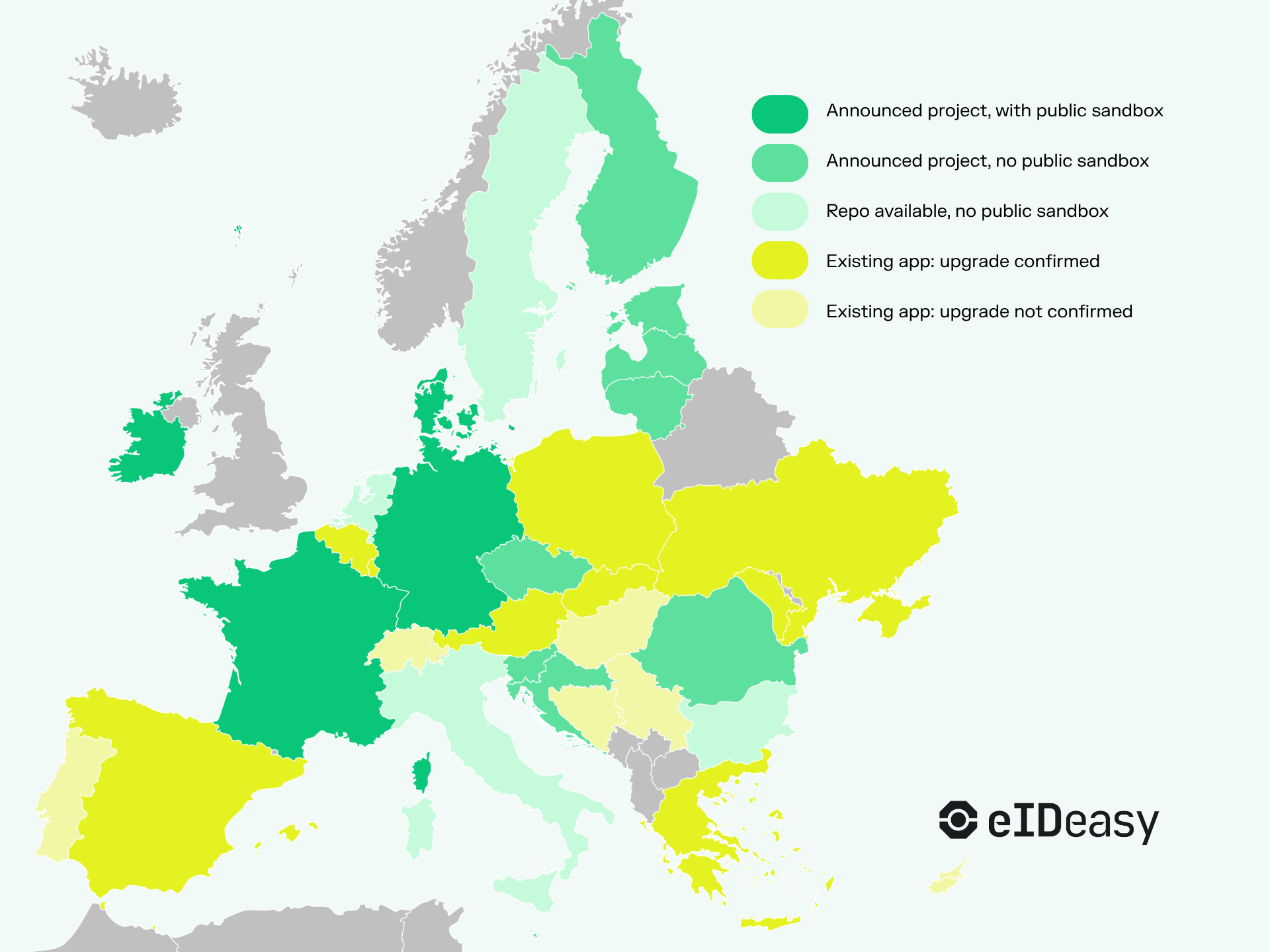
With most countries still publicly holding the line that they will meet the EU’s deadline of December 2026 to deliver a first working EUDIW implementation, assessing preparedness can be tricky.
So we’ve used a range of publicly available information sources - announcements, speeches, presentations, even developer resources - to come up with a sense of how far advanced the different countries are.
The results are shown in the table below, which gives a state of play as of 6 April 2026.
Preparedness Levels Explained:
|
Preparedness Definition |
|
Announced Project (with Public Sandbox)
A nationally announced EU Digital Identity Wallet implementation project with an official public sandbox or playground environment (including documentation) intended for external ecosystem testing.
|
|
Announced Project, No Public Sandbox
A publicly announced EU Digital Identity Wallet implementation project exists, but no public sandbox is available. Testing may be limited to closed pilots, beta environments, or selected participants.
|
|
Public Developer Repository Available
A publicly announced EU Digital Identity Wallet implementation project exists, with a publicly accessible GitHub repository or official developer materials, but no confirmed sandbox or beta testing environment.
|
|
Existing National Identity App Confirmed for Upgrade
An existing national identity application is in use, and the government has officially confirmed that it will be upgraded to comply with the EU Digital Identity Wallet Regulation.
|
|
Existing Identity App, Upgrade Not Yet Confirmed
An existing national identity app is in place, but no official confirmation has been found that it will be upgraded to comply with the EU Digital Identity Wallet Regulation.
|
| Country |
Group |
National Wallet / Project |
Preparedness |
Responsible Authority |
| Austria | EU Member State | eAusweise / ID Austria | Existing app: upgrade confirmed | Federal Chancellery / Digital Austria |
| Belgium | EU Member State | MyGov.be | Existing app: upgrade confirmed | FPS Policy and Support |
| Bulgaria | EU Member State | Bulgarian EUDI Wallet | Public repo (no sandbox) | Ministry of e-Government |
| Croatia | EU Member State | National EUDI Wallet | Announced project (no public sandbox) | Ministry of Justice & Digital Transformation |
| Cyprus | EU Member State | National eID | Existing app: upgrade not confirmed | Deputy Ministry of Digital Policy |
| Czechia | EU Member State | DIA EUDI Programme | Announced project (no public sandbox) | Digital and Information Agency |
| Denmark | EU Member State | AltID | Announced project (with public sandbox) | Agency for Digital Government |
| Estonia | EU Member State | EUDI Wallet Estonia | Announced project (no public sandbox) | Information System Authority |
| Finland | EU Member State | National Digital Identity Wallet | Public repo (no sandbox) | Digital and Population Data Services Agency |
| France | EU Member State | France Identité | Announced project (with public sandbox) | France Titres |
| Germany | EU Member State | State EUDI Wallet | Announced project (with public sandbox) | Federal Ministry for Digital Affairs |
| Greece | EU Member State | Gov.gr Wallet | Existing app: upgrade confirmed | Ministry of Digital Governance |
| Hungary | EU Member State | DÁP Wallet | Existing app: upgrade not confirmed | Hungarian Government |
| Ireland | EU Member State | Government Digital Wallet | Announced project (with public sandbox) | Irish Government |
| Italy | EU Member State | Sistema IT-Wallet | Public repo (no sandbox) | Department for Digital Transformation |
| Latvia | EU Member State | EUDI Wallet Latvia | Announced project (no public sandbox) | State Digital Development Agency |
| Lithuania | EU Member State | EUDI Pilot | Announced project (no public sandbox) | Informatics and Communications Department |
| Luxembourg | EU Member State | EUDI Wallet | Existing app: upgrade confirmed | Ministry for Digitalisation |
| Malta | EU Member State | National Digital Wallet | Announced project (no public sandbox) | Malta Digital Innovation Authority |
| Netherlands | EU Member State | NL Wallet | Public repo (no sandbox) | Ministry of the Interior |
| Poland | EU Member State | mObywatel | Existing app: upgrade confirmed | Ministry of Digital Affairs |
| Portugal | EU Member State | gov.pt Wallet | Existing app: upgrade not confirmed | Agency for Administrative Modernisation |
| Romania | EU Member State | EUDI Wallet Romania | Announced project (no public sandbox) | Authority for the Digitalization of Romania |
| Slovakia | EU Member State | eDOKLADY | Existing app: upgrade confirmed | Ministry of Interior |
| Slovenia | EU Member State | EUDI Wallet Slovenia | Announced project (no public sandbox) | Ministry of Digital Transformation |
| Spain | EU Member State | Cartera Digital | Existing app: upgrade confirmed | Ministry for Digital Transformation |
| Sweden | EU Member State | Digital identitetsplånbok | Announced project (no public sandbox) | Agency for Digital Government |
| Bosnia and Herzegovina | EU Candidate Country | e-IDDEEA app / Digital ID Wallet Platform | Existing app: upgrade not confirmed | Agency for Identification Documents |
| Serbia | EU Candidate Country | eID Portal / ConsentID | Existing app: upgrade not confirmed | Office for IT and eGovernment |
| Ukraine | EU Candidate Country | Diia | Existing app: upgrade confirmed | Ministry of Digital Transformation |
| Moldova | EU Candidate Country | EVO / EVOSign | Existing app: upgrade confirmed | Electronic Governance Agency |
| Switzerland | Switzerland | swiyu Wallet | Existing app: upgrade not confirmed | Swiss Confederation |
→ Snapshot maintained by eID Easy Provider Relations.
See something that doesn't look right? Drop us a message and we'll investigate.
Denmark and Ireland Open Things Up
Denmark and Ireland both took a step in the same direction this month: opening up access to their wallet projects.
- Denmark has launched a public sandbox, while
- Ireland announced early public access to a test wallet.
These projects are moving from planning into something developers can actually start working with.
→ They now sit alongside France and Germany as the most accessible ecosystems right now.
More Materials From Developers
Bulgaria, Finland, Italy, and the Netherlands now have public repositories or developer materials linked to their wallet work.
Developers looking to understand these wallets can see technical specifications, and familiarise themselves with implementation framework and design requirements.
Looking Beyond the EU
Based on feedback, we’ve expanded the snapshot to include EU candidate countries where we have seen digital wallet projects.
What’s interesting here is that Ukraine and Moldova are not just participating, they’re among the more active ones right now. Moldova has an upcoming Digital Summit including a wallet testing exercise: Moldova Digital Summit - Where Digital Vision Meets European Ambition.
Switzerland has launched a public beta of its swiyu infrastructure, which puts it ahead of many EU countries in terms of openness.
Still Early For Most
At the same time, not much has changed for a large part of Europe.
In many countries, there’s still no clear way for the outside world to engage. No sandbox, no developer docs, no obvious entry point.
So while progress is happening, it’s uneven, and still largely behind the scenes in many places.
Why This Matters
For organisations operating across borders, the EU Digital Identity Wallet rollout will not happen in one single moment.
It will be gradual. Country by country. Use case by use case.
Understanding where each Member State stands helps answer practical questions:
- Where should we prioritise integration?
- Which markets are ready for wallet-based onboarding?
- Where will adoption likely come fastest?
- Where are we still looking at infrastructure build-out?
eID Easy's Role
That visibility is part of what we track continuously at eID Easy.
Today, we already connect organisations to national eIDs and bank-based identity schemes across Europe. As EU Digital Identity Wallets become available in each country, they will be added alongside those existing methods.
One integration. Multiple identity methods.
→ Interested in current national eIDs, Bank IDs, and, as they launch, EU Digital Identity Wallets? Let's have a chat or send us a message.