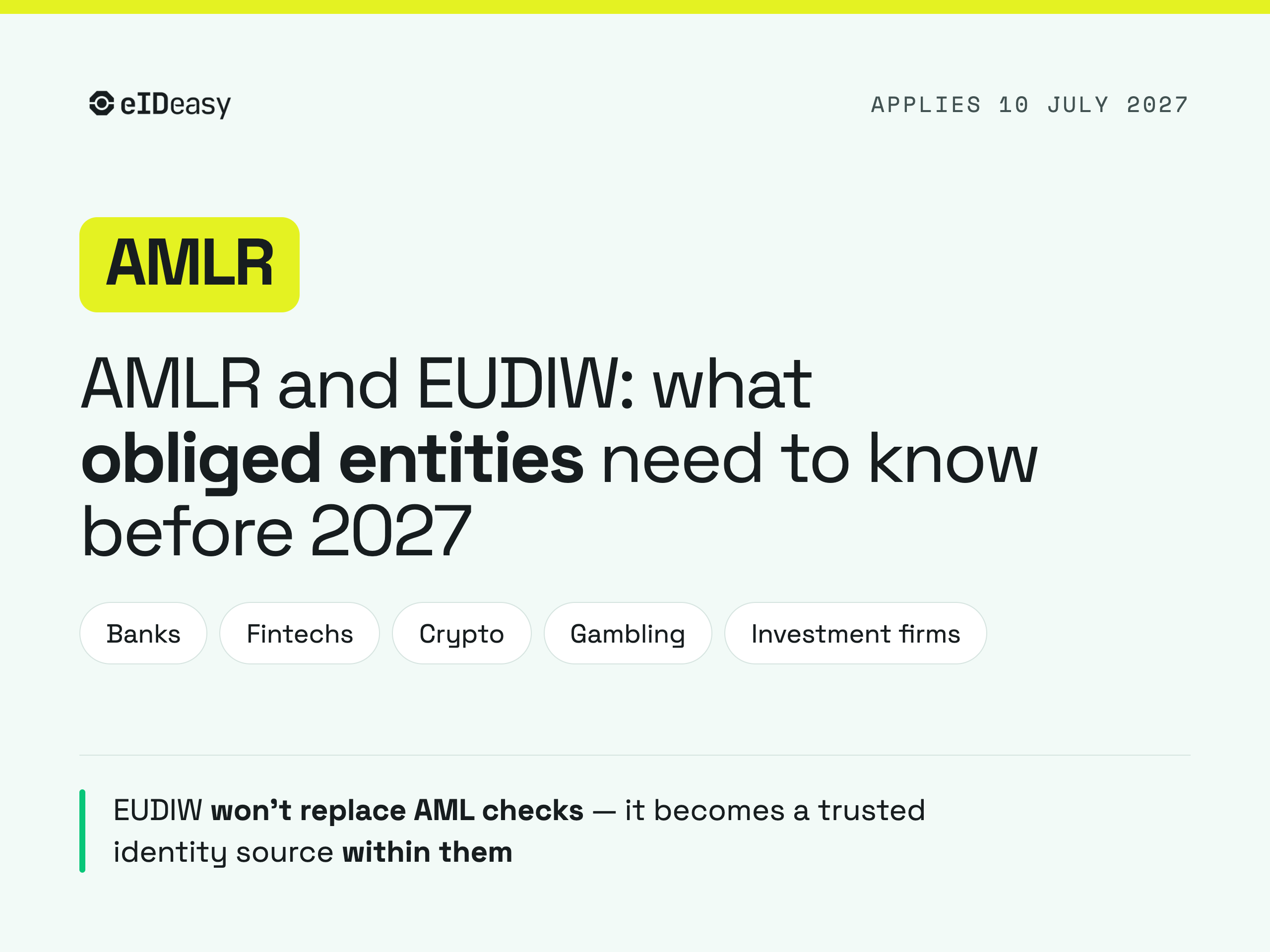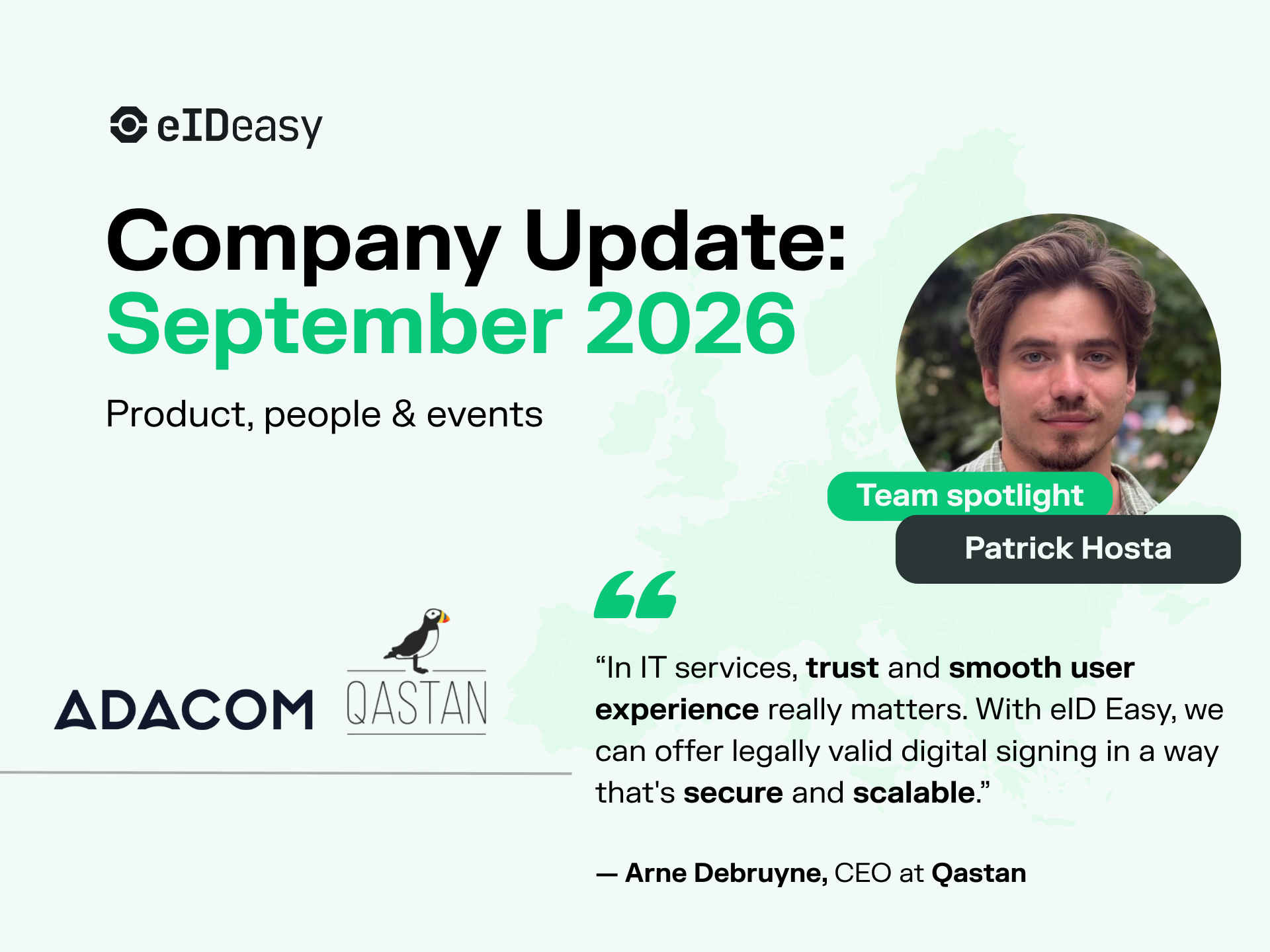
Here’s a quick look at what we built in the past month, what’s moving forward on the roadmap, and where the team has been active across the ecosystem.
Product progress, partnerships, and the people behind it: all in one place.
1. Product Update: XAdES eSealing and EUDIW Playground Updates
In September, the product team worked on two useful updates: more flexibility for Cloud Direct eSealing and a clearer way to explore EUDI Wallet flows.
Cloud Direct eSeal: XAdES support for XML-based workflows
We added support for XML-based Enveloped XAdES signatures in our Cloud Direct eSeal flow, making it more useful for structured, regulated XML documents.
As the automotive sector prepares for fully digital, qualified signed electronic Certificates of Conformity (eCoC), manufacturers and platforms need a reliable way to seal XML documents without building the trust-service layer themselves.
Customers now have two options:
→ Full-file XAdES sealing lets customers send the original XML file to eID Easy and receive a complete signed XML file back.
→ Reference digest XAdES sealing is designed for privacy-sensitive workflows. Instead of sending the full XML file, customers can send the canonicalized XML digest and receive signature fragments to insert into the original XML.
Both options also support the failover and redundancy setup we already use for CAdES signatures. The feature is currently in final production testing.
Documentation is available here:
→ Full-file XAdES sealing
→ Reference digest XAdES sealing
EUDIW Playground update
We also updated the eID Easy EUDIW Playground, making it easier to explore what wallet-based identity flows look like in practice.
The page now gives users two ways to experience digital identity:
Industry demos show familiar customer journeys, such as renting a car, opening an account, or catching a film, with digital identity built into the flow.
Technical playground lets teams get closer to the integration side: OAuth redirects, wallet QR codes, credential selection, and returned data.
The goal is to make EUDI Wallets easier to understand for both business and technical teams — whether they want to see the end-user experience or inspect what happens behind the scenes.
→ Explore it here: https://eudiw-playground.eideasy.com/
2. Coming Up Next: What Product Team Is Working On
The product team is still focused on two national eID methods and one wallet sandbox: SPID in Italy, mObywatel in Poland, and the Swiss Swiyu wallet sandbox.
It’s a good reminder of why aggregation matters. Adding national eID schemes is not always a simple technical switch. There are registrations, approvals, government processes, local rules, and plenty of moving parts that do not always depend on us.
That is exactly the kind of complexity we work through, so customers do not have to go direct to every scheme country by country.
Near-term priorities:
SPID, Italy
We’re being onboarded as an official SPID aggregator, which will allow us to offer SPID as an authentication method through the eID Easy API. This is a major step for customers who need to verify Italian users online, especially for onboarding, account access, and regulated user flows.
mObywatel, Poland
mObywatel is also on the near-term roadmap, helping us expand eID coverage in Poland. Once available, it will support businesses that need to authenticate Polish users as part of online services, onboarding, or other digital journeys.
Swiss Wallet, Swiyu
On the wallet side, we’re preparing access to the Swiss Swiyu wallet sandbox. This will allow customers to test wallet-based journeys, including identity credential verification and trusted attribute sharing, before production access becomes available.
National Italian Wallet
We’re also preparing support for the National Italian Wallet, adding another wallet environment to our EUDI Wallet work and helping customers explore future Italian wallet-based identity flows.
Together, these updates support the same goal: broader trusted identity coverage through one API, with early access to the wallet-based flows that are coming next.
2026 Roadmap Highlights
- Digital Identity Wallet (DIW) integrations, with business-ready flows and APIs
- Expanded eID coverage across Europe (Poland, Italy, Spain, Germany, and more)
- Uptime and performance improvements across high-demand methods
- Enhanced analytics and reporting for better operational and client insights
3. Customer Story of the Month
This month, we’re highlighting QASTAN, an IT services and software development company focused on digitalisation and document management solutions.
QASTAN is using eID Easy to support document signing inside its document management and workflow solutions, with underlying identity verification of the signer. The first focus is the petroleum market, with plans to expand into other markets as well.
The goal is simple: replace paper-based and manual signing processes with legally valid digital signing, so document workflows become faster, paperless, and more reliable for QASTAN’s clients.
As more of their customers digitalise, QASTAN can now offer secure and scalable eSignatures through eID Easy, helping modernise document journeys without adding unnecessary complexity.
“In IT services, trust and smooth user experience really matters. With eID Easy, we can offer legally valid digital signing in a way that's secure and scalable.”
— Arne Debruyne, CEO at QASTAN
4. Provider Story of the Month
ADACOM, a leading QTSP for one-shot remote signing
This month, we’re highlighting ADACOM, a leading Qualified Trust Services Provider, Cybersecurity Integrator, and Managed Security Services Provider with headquarters in Athens, Greece, and subsidiaries in Cyprus and the Kingdom of Bahrain.
ADACOM is one of our most widely used remote-signature partners, thanks to its one-shot signing service.
Through eID Easy’s API, our customers can offer ADACOM’s one-shot signing service to their users without building a separate integration. New users can complete remote onboarding and identity verification, receive a single-use signing certificate on the spot, and immediately sign a document. All in one flow.
This is particularly useful when signatories don’t already have an electronic identity or can’t be expected to download an app. Identity verification takes place directly in the browser, so users can sign from any device with an internet connection and a camera.
“At ADACOM, we believe that qualified electronic signatures should offer the highest levels of trust and regulatory compliance without compromising ease of use. Our partnership with eID Easy makes this possible by integrating ADACOM’s one-shot remote signing service into a seamless end-to-end journey. Together, we are making secure and trusted signing more accessible to businesses and users across Europe.”
— Kostas Noussias, Trust Services Director at ADACOM
A big thank you to the ADACOM team for being a great partner and helping us make remote signing simpler for our customers and their users.
5. Around the Company: Events, Updates & More
September was a busy month across the digital identity and trust services calendar, with the team active across Geneva, Brussels, Tallinn, Thailand, Zürich, London, and EUDI Wallet interoperability testing.
Global Digital Collaboration Conference, Geneva
Maoiliosa started the month in Geneva at the Global Digital Collaboration Conference, a gathering focused on digital trust infrastructure, interoperability, wallets, verifiable credentials, standards, and cross-border collaboration.
A fitting place to start September, with many of the conversations we care about most: trust, identity, wallets, and how all of this works across borders.
Digital Identity Community Drinks, Brussels
We brought our Digital Identity Community Drinks Meetup series to Brussels for the first time, co-hosted with our good friends at itsme®.
For our team, the meetup was a great opportunity to meet with clients in Belgium who use eID Easy to access itsme® eID and eSignatures. It was also the first event we organised together with one of our providers, making it a nice step in our partnership with itsme®.
Belgium continues to be one of our strongest markets, and one where we expect to see continued growth.
CSC 10th Anniversary Dinner and ENISA Trust Services Forum, Tallinn
Tallinn had a busy trust services week too.
First, we co-hosted a Cloud Signature Consortium 10th Anniversary Dinner, bringing together CSC members, partners, and friends to mark 10 years of collaboration around cloud signatures and digital trust.

The next days continued with the ENISA Trust Services and eID Forum – CA Day 2026, where digital identity wallets were, unsurprisingly, a major topic.
As John put it:
“What became really clear in Tallinn is that the schemes needed to certify national wallet projects at national and EU level are far from being in place. The result? We’ll have a patchwork of national wallets available at different times, with different features, and available to different audiences, for quite some time before we can start talking about a working EUDIW ecosystem.”
There was also plenty of discussion around the commercial side of wallets, from relying party adoption to the future role of intermediaries and QTSPs issuing qualified attestations.
Exploring APAC Opportunities in Thailand
Joao spent a week in Thailand from September 21–25, exploring opportunities for eID Easy to grow in APAC.
The trip was a chance to see how ThaiID is used in real life, meet people on the ground, and better understand how local businesses approach digital identity in practice.
He also spent time with local companies looking to grow into Europe, where they need to navigate the EU compliance landscape, trusted signing requirements, and cross-border identity challenges.
UNFOLD #4.1 Interoperability Testing
Andrii, our Senior Lead Developer joined UNFOLD #4.1, an interoperability testing event focused on how different countries and EUDI services work together across issuers, wallets, and verifiers.
This time, our team focused on keeping compatibility current across the wallet ecosystem. We added a Turkish wallet into testing, continued work with wallet environments including Namirial, Cleverbase Wallet, Docaposte Wallet, France Identité, and MIA by youniqx, updated our HAIP profile, rolled up our relying party demos, and kept compatibility aligned with the latest trust setup in the interoperability testing environment.
As Andrii is working hands-on with wallet integrations, he shares:
“Every interoperability event brings more government and private projects on board. Even when we are not actively testing every flow ourselves, the work is about keeping up with the ecosystem: new wallets, new approvals, updated profiles, relying party demos, and changing trust setups.”
A very practical reminder that wallet readiness is not one big launch moment. It is ongoing testing, updating, adjusting, and making sure the pieces can actually talk to each other.
Proof Up 2026, Zürich
John also attended Proof Up 2026, hosted by Swisscom Trust Services in Zürich.
His takeaway:
"It was a thoughtful and well-organised event, with a highly energised partner ecosystem and a clear message that digital trust is becoming part of wider auditable business systems."
Digital signatures, seals, timestamps, verified identities, and trusted attributes are no longer just point products. They are becoming building blocks for business processes where proof, origin, integrity, and compliance need to be verifiable.
The event also included strong partner demos, from digital product passports to next-generation KYC and onboarding, and legal entity identity use cases.
Digital Identity Community Meetup, London
We wrapped up the month with another Digital Identity Community Meetup, this time in London on September 29.

It was another great turnout, with good conversations, a friendly atmosphere, and plenty of new connections.
The UK can sometimes feel a little on the sidelines of the digital identity and EUDI Wallet discussion, but for financial institutions working in Europe, the topic is becoming harder to ignore.
Among others, Joao, Maoiliosa, and Calum from our team had a pleasure to speak with Mike Hathaway from Ascertia, Simon Peralta from IDnow, and Alexandra Romanova from Visa about how their companies and clients are approaching the EUDI Wallet project.
Coming in October
So far, we have two events locked in for October.
Trusted Economy Forum, Poznan
Piotr Andruszkiewicz, our Head of Sales eID & EUDI, will be speaking at the Trusted Economy Forum 2026 on October 15, joining a debate on “What Customers Really Need: Expectations for Digital Identity, Trust Services and Digital Transformation.”
The forum takes place on October 14–15 and brings together people working across digital identity, trust services, and digital transformation.
🇪🇸 eID Easy Meetup #16: Barcelona Edition
We’re also bringing our Digital Identity Community Meetup series to Barcelona for the first time on October 20.
Maoiliosa, João, and Patrick will be there from the eID Easy team, with Patrick Hosta joining on home ground as our Barcelona-based Sales Lead.
Same idea as always: relaxed conversations around digital identity, EUDI Wallets, eSignatures, trust services, onboarding, compliance, and what all of this looks like in practice.
RSVP: eID Easy Meetup: Barcelona Edition
6. Under the Hood: Team Spotlight
This month, we’re putting the spotlight on Patrick Hosta, our Sales Lead at eID Easy.
Patrick works closely with new prospects, existing customers, and partners across different markets and use cases. One day, that might mean talking to a fintech about QES. The next, it could be helping an automotive company understand eCoC requirements, or speaking with a bank about EUDI Wallet readiness.
In short: Patrick spends a lot of time where business problems, regulation, and digital identity meet.
What do you do at eID Easy?
"Great question.
I’m a Sales Lead. In simple terms, I find and bring on new clients, and help existing ones grow what they do with us.
That means sourcing new business, picking up inbound interest, setting up partnerships, and working with current clients when they want to expand their use of eID Easy.
I also look for new markets and use cases where our services can solve a real business problem, whether that’s a new country, a new industry, or a new way of using digital identity services."
What were you doing before eID Easy?
"Most of my career has been in the fintech space in Ireland.
I’ve worked with a wide range of clients, from local SMEs to multinational enterprise accounts. The size and complexity change, but the job is always the same: understand what the client is trying to achieve and find the simplest way to get them there."
What made you join eID Easy?
"Relevance.
Digital identity is becoming part of everyday life. It makes things more secure and lets more people take part in the digital economy.
With eSignatures becoming more relevant every day, and eIDAS 2.0 and the EU Digital Identity Wallet on the way, the industry is at a real turning point.
It’s exciting to be working in a space at that kind of crossroads, and eID Easy’s position as an aggregator puts us right in the middle of it."
What makes sales at eID Easy interesting?
"No two conversations are ever the same.
One day it’s eCoC for a car manufacturer, the next it’s QES for a fintech, or EUDI Wallet readiness for a bank.
Each customer has a different regulatory starting point and a different problem they want solved, so every conversation is more of a problem-solving exercise than a direct sales conversation.
The industry also moves extremely fast. I’m learning something new every day, and I don’t think I’ll ever feel fully on top of it, which is exactly what I enjoy about it."

What are customers asking about right now?
"Wallets.
Almost every conversation now touches on the EU Digital Identity Wallet at some point, whether it’s a bank asking how to prepare or a platform wondering what it means for their onboarding.
Beyond that, new eSignature use cases come up every week.
We’re also seeing regulation drive conversations in waves. eCoC has definitely been the big one this year, and now it’s the Digital Product Passport. When a new requirement lands, a whole sector suddenly needs trust services, and they need them to be fully compliant from day one."
What do prospects often misunderstand at first?
"Usually, that the problem they came to us with is far easier to solve than they thought.
One integration gives them access to global trust service providers, so they can navigate changing business needs through one integration.
It reduces complexity and makes a hard requirement on the client side much easier to achieve."
What kind of customer problems do you enjoy solving most?
"For me, it’s definitely exploring new markets and use cases.
I like getting to know an industry, understanding how it works, and figuring out where our solution can help.
I also enjoy helping businesses digitalise and streamline their identity and signing workflows, because through our APIs, we’re adding real value to the businesses we work with and to their end users."
What does good sales mean to you?
"I think good sales is about relationship building for long-term partnerships.
We’re not closing one-off deals. We’re building partnerships that last years, and that only works if there’s real trust on both sides.
It also means being responsible.
A lot of customers look to us as the experts in this field and rely on our guidance, so it’s on us to give them honest advice about what they actually need, even when that isn’t the biggest deal on the table, or when part of our solution might not be the right fit."
What does “making trust simple” mean to you?
"It means cutting through a lot of the jargon and acronyms, and explaining what it actually means for a prospect’s business.
Most customers don’t need to know every eIDAS assurance level. They just need to know which signature they need, why they need it, what it costs, and how fast they can go live
On the product side, it’s one integration instead of many, so we carry the complexity, not them.
If someone goes from “not sure what I need” to a working, compliant flow without becoming an expert, I reckon we’ve done our job."
We’re glad to have Patrick on the team, helping customers turn complicated identity, signature, and compliance questions into practical next steps.
7. Resources & Useful Links
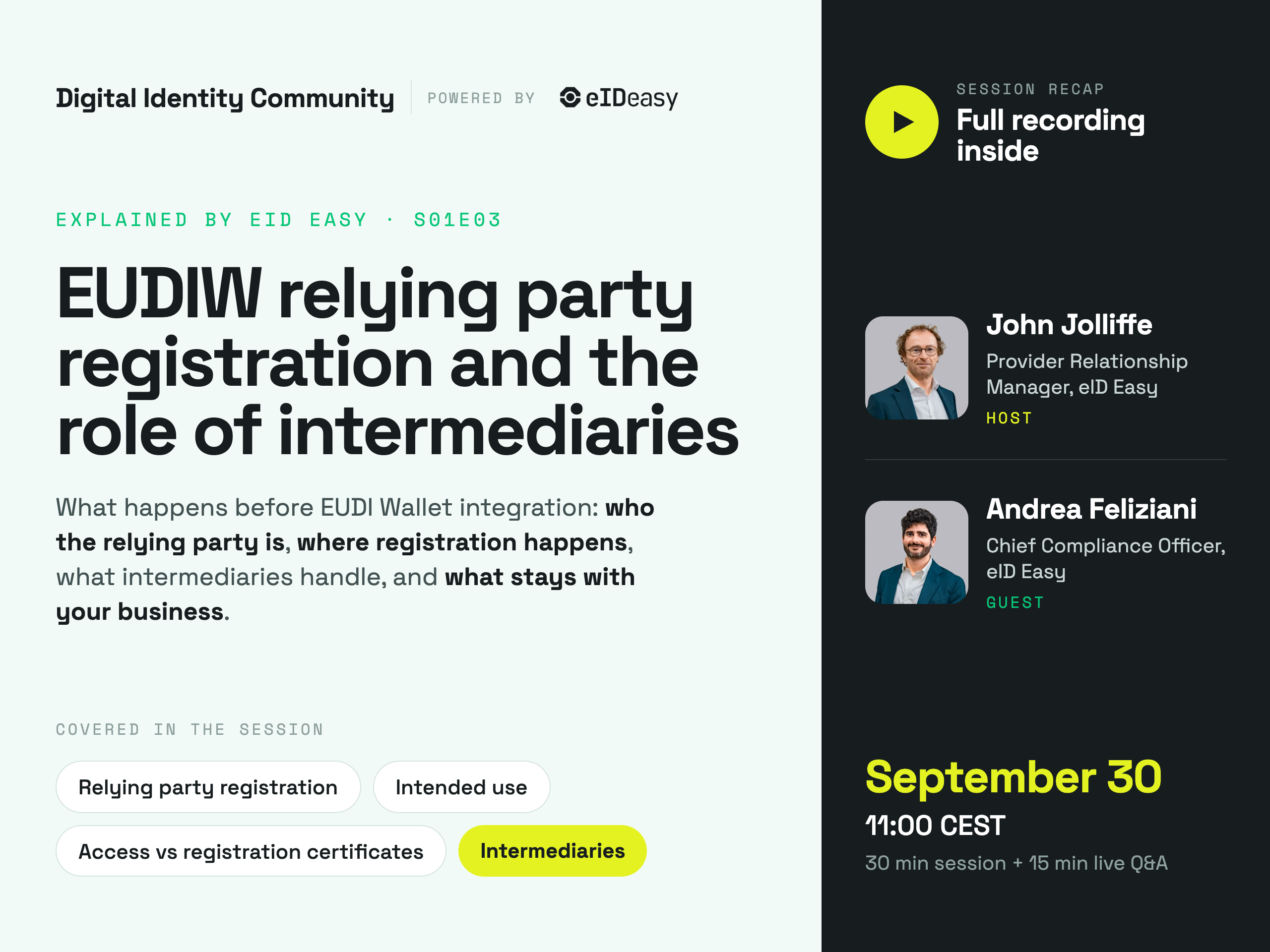
EUDIW live session recap: what relying parties need to know
In our third Explained by eID Easy live session, we moved from wallet demos to the questions businesses need to answer before they start integrating.
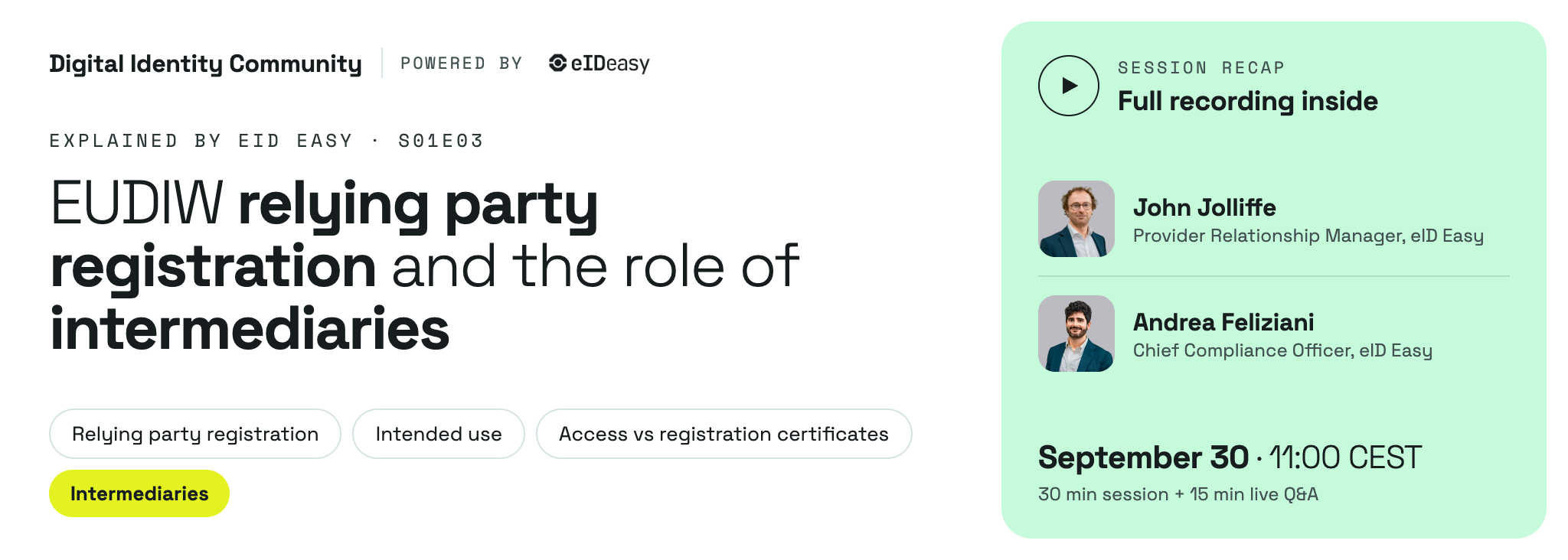
This session focused on relying party registration, what data a business should request from a wallet, how registration and access certificates differ, and what changes when an intermediary like eID Easy handles the wallet interaction on behalf of the relying party.
The main takeaway: wallet readiness does not start with an API call.
It starts with understanding:
- which legal entity provides the service
- what customer journey you want to support
- what information you actually need
- who handles registration and certificates
- what the end user will see in the wallet flow
For businesses looking at EUDIW, the best place to start is one clear use case, not every possible wallet scenario at once.
→ Read the recap and watch the recording
Explore More
→ Sign up for product updates – One email per month. No spam.
→ Follow us on LinkedIn – Product news, team stories, and events.
Thanks for reading and for being part of the growing eID Easy community. If something here caught your eye, a product update, an event, a use case, we’d love to talk more.
Catch you next month with more updates from across the company.