We’re continuing to track EU Digital Identity Wallet progress across Europe, including EU Member States, candidate countries, EEA EFTA states, Switzerland and, from this update, the United Kingdom as a non-EU comparator.
Our focus remains practical: what can organisations actually test, inspect or prepare to integrate? We look at public sandboxes, developer documentation, national implementation plans and the access routes available to relying parties—the organisations requesting information from wallets.
What changed since September?
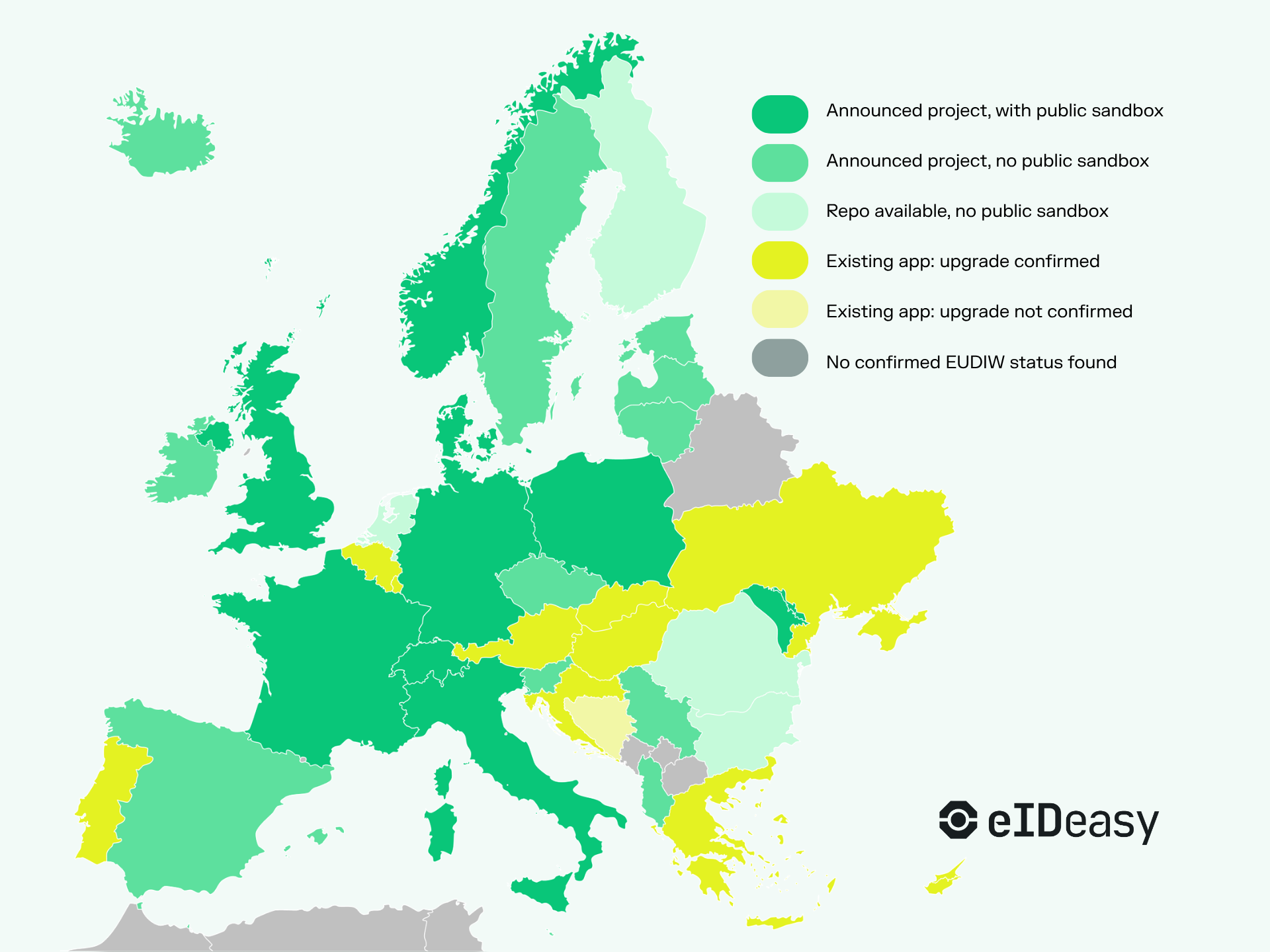
Compared with our September snapshot, the category changes are:
- Poland: Category 4 → Category 1
- Cyprus: Category 5 → Category 4
- Serbia: Category 5 → Category 2
- Türkiye: Category 6 → Category 3
- United Kingdom: newly added as a Category 1 non-EU comparator
Romania and Sweden keep their current classifications, but both are approaching important testing milestones. Their expected sandbox launches are covered below.
How we classify EUDIW readiness
Our categories describe the evidence available for each project. They are not a certification score or a ranking of production-ready wallets.
For Category 1, we look for a live external test environment with a published access route. Access can require an application, eligibility checks or manual approval; it does not have to be open to everyone without registration.
EUDIW status snapshot — 15 October 2026
The table below brings together our latest country review and subsequent updates. Planned launches remain separate from environments that are already available.
Snapshot maintained by eID Easy Provider Relations. See something that needs updating? Send us a message.
Poland opens its wallet sandbox to external organisations
Poland launched the EPTC Sandbox on 16 September 2026, giving companies and institutions a published route to apply for free access. Approved participants receive a demonstration version of mObywatel Europa and can initially test identity-data presentation and verification through a web verifier.
That moves Poland into Category 1. Access is subject to application review, but organisations outside the project now have a clear way to request entry and start testing. This is sandbox access—not a claim that the production EUDI Wallet has launched.
Cyprus confirms the Digital Citizen upgrade path
Cyprus’s Digital Citizen 2.0 procurement, launched in September, explicitly includes integrating national EUDI Wallet functions into the existing Digital Citizen application. This confirms the existing-app upgrade path behind its move to Category 4. The tracker does not yet record a public EUDI sandbox or a certified production wallet. eudiw_oct14_source_notes.txt
Serbia and Türkiye receive updated classifications
Serbia moves to Category 2 around the SERVIS Digital Wallet project. The Office for IT and eGovernment describes SERVIS as a proposed initiative with an EUDI-aligned digital wallet as a central feature. ConsentID remains the existing eID application; SERVIS is the announced wallet project being tracked here. Public sandbox access has not been confirmed in this review.
Türkiye moves to Category 3 for Digital Türkiye Wallet (DTC). The latest review records concrete project activity and participation in wallet interoperability events, replacing the previous “no confirmed status” classification. The project’s own description also identifies international standards and the EUDI Wallet ecosystem as part of its development direction.
The United Kingdom joins as a non-EU comparator
We have added GOV.UK Wallet because its sandbox offers a useful comparison for practical wallet testing outside the EU framework.
Official guidance published on 1 September 2026 sets out the access route: Digital Verification Service providers must first be certified against the UK trust framework and registered, then request sandbox access. The environment includes a test wallet, credential tools and a certificate authority, allowing eligible providers to test sharing and verifying a digital driving licence.
The UK is recorded as Category 1 for comparable testability only. Its inclusion does not imply that GOV.UK Wallet is an EUDI Wallet or subject to the same legal framework. eudiw_oct14_source_notes.txt
Next up: public sandboxes in Romania and Sweden
As deadlines approach, we’re seeing activity speed up across Europe. We expect Romania and Sweden to move into Category 1 as their publicly available test environments open over the coming weeks and months.
Romania has indicated the end of October, with its official roadmap scheduling the RO Wallet test version, interoperability test bed and sandbox for 31 October 2026. A restricted beta is planned for 22 December 2026, followed by the official v1 launch targeted for 14 January 2027.
Sweden has stated that its test environment will be available in December 2026. DIGG’s roadmap describes a first wallet version in a test platform that relying parties and attribute issuers can use to test solutions and participate in ecosystem development.
For this snapshot, Romania stays in Category 3 and Sweden stays in Category 2. Those expected moves depend on the environments becoming available with a published external access route—not simply on reaching an announced date.
Other developments worth noting
Germany names its wallet and sets a launch target
Germany’s state wallet is now called d-you, with a planned launch on 2 January 2027 and around 40 launch partners. Germany remains in Category 1; the update adds a clearer production target rather than changing its existing sandbox classification.
Moldova and Norway expand practical testing
Moldova remains in Category 1. Its EVO integration documentation describes verifier onboarding, certificate requests and access to a staging environment. However, the tracker retains an important limitation: access for foreign entities remains constrained by onboarding requirements within Moldova’s national trust scheme.
Norway also remains in Category 1. Digipost’s credential-issuance API and verification service are available in the national sandbox. Municipalities and suppliers also used the environment to develop and test public-service prototypes at a September hackathon.
Certification, documentation and procurement continue
Czechia stays in Category 2 after submitting a draft national wallet certification scheme for Member State review. Finland stays in Category 3, with refreshed Suomi.fi Wallet documentation but no confirmed external relying-party sandbox in the review. Malta remains in Category 2 while procurement continues.
North Macedonia remains in Category 2. Its m.Услуги application is under testing, with an stated aim of evolving into a European wallet by 2028. Domestic app testing is not being counted as an external EUDI ecosystem sandbox.
What this means for organisations preparing for wallets
The useful development is that more projects now offer something concrete to work with: a test environment, an application route, developer materials or a published timetable. Poland’s sandbox and the planned Romanian and Swedish environments give teams more specific opportunities to plan around.
The next question is whether that access fits your organisation and use case. Check who can join, which credentials can be tested and whether the environment supports the workflow you need—not just whether a sandbox exists.
At eID Easy, we continue to monitor procurement, registration and certification activity and will report on it when it changes practical access through our Wallet Hub. Our approach is to bring wallet access alongside existing national eIDs and bank-based identity methods, rather than leave customers to follow each national implementation alone.
Want to start testing wallet-based identity?