Actualización de la empresa, enero de 2026: un breve resumen de lo que hemos creado, lo que está por venir y quiénes lo están dando forma.
Más información
Launch QES-enabled prescription signing in Germany, then expand across Europe with trusted local QES and AdES methods through one API.
eID Easy helps telemedicine platforms, digital clinics, practice-management software, ePrescription vendors, and veterinary systems add trusted electronic signatures to online prescription workflows.
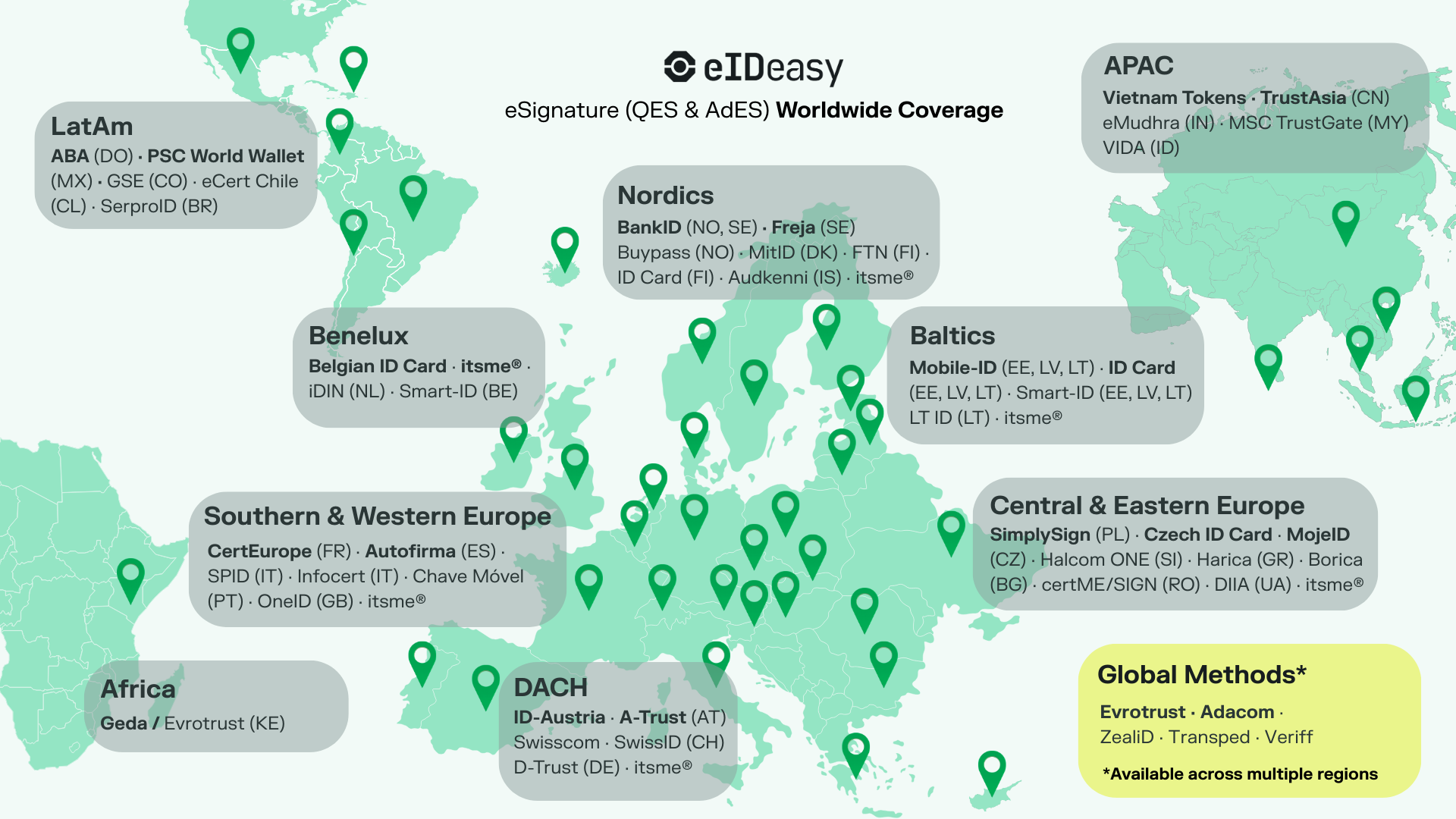
Connect once to a worldwide network of 80+ trusted eSignature and eID providers and methods, including Qualified and Advanced Electronic Signature options.
Start with the QES requirement for electronic prescriptions in Germany, then enable additional supported markets without rebuilding your core signing infrastructure.







Your platform manages the teleconsultation, clinical decision, prescription data, and connection to the relevant pharmacy or national system. eID Easy manages the trust-provider layer that identifies the prescriber, enables the configured electronic signature method, and returns the signed result.
An ePrescription signature API removes the need to integrate every Qualified Trust Service Provider or certificate authority separately. Your product decides which providers and methods are available, so doctors and veterinarians do not need to choose from the entire eID Easy network whenever they prescribe.


The consultation can be complete and the prescription data ready, yet the workflow still fails if the required electronic signature is missing or cannot be verified.
Adding another country often means repeating the same provider selection, contracting, integration, testing, and maintenance work from the beginning.

eID Easy lets you configure the provider and signature level around the use case: where your prescribers are located, how frequently they will sign, and which markets you plan to enter.
With eID Easy, your platform remains in control of prescription creation, clinical rules, and delivery to the appropriate healthcare infrastructure.

Under §2 of Germany’s Arzneimittelverschreibungsverordnung, a prescription issued in electronic form must include the Qualified Electronic Signature of the prescribing person.
The provision covers medical, dental, and veterinary prescribers and also defines additional information requirements for veterinary prescriptions.

Under Article 25 of the eIDAS Regulation, a Qualified Electronic Signature has the equivalent legal effect of a handwritten signature.
A QES based on a qualified certificate issued in one EU Member State must also be recognised as a QES in the other Member States.

Each country can still determine how prescriptions are created, transmitted, stored, retrieved, and dispensed.
In Germany, the national E-Rezept is created digitally, signed, stored in the central E-Rezept service, and retrieved by pharmacies through the Telematikinfrastruktur.

Start with QES for electronic prescriptions in Germany or select the appropriate supported method for another prescription workflow.
Your platform can enable only the providers and methods you want prescribers to use, rather than showing every available option.
The prescriber completes the identity-verification and certificate-activation process required by the selected provider.
Depending on the provider and certificate model, onboarding may be completed initially or periodically rather than repeated from the beginning for every prescription.
After the consultation, your platform creates the prescription and initiates the eID Easy signing flow.
The doctor or veterinarian reviews the prescription and completes the authentication, consent, or approval steps required by the configured provider.
eID Easy returns the signed prescription, signature container, or signing result to your system.
Your platform can then continue the relevant workflow, whether that involves a pharmacy integration, Germany’s E-Rezept infrastructure, or another market-specific channel.
At a technical level, the standard eID Easy flow is to prepare the content, let the user complete the provider-specific signing process, and retrieve the signed result.

Solve the German QES requirement first, then enable additional signature providers and methods as you enter new markets.

Configure the solution around a known group of doctors or veterinarians issuing prescriptions frequently, rather than treating every signature as an unrelated one-off journey.

Access a worldwide network of Qualified Trust Service Providers, certificate authorities, and supported eSignature and eID methods without maintaining every integration separately.

Use a hosted signing page, an embeddable widget, browser-side components, or a fully API-based flow while keeping the prescription journey inside your own product.

Reduce the number of direct provider integrations, contracts, onboarding processes, support paths, and technical dependencies your team must manage.

