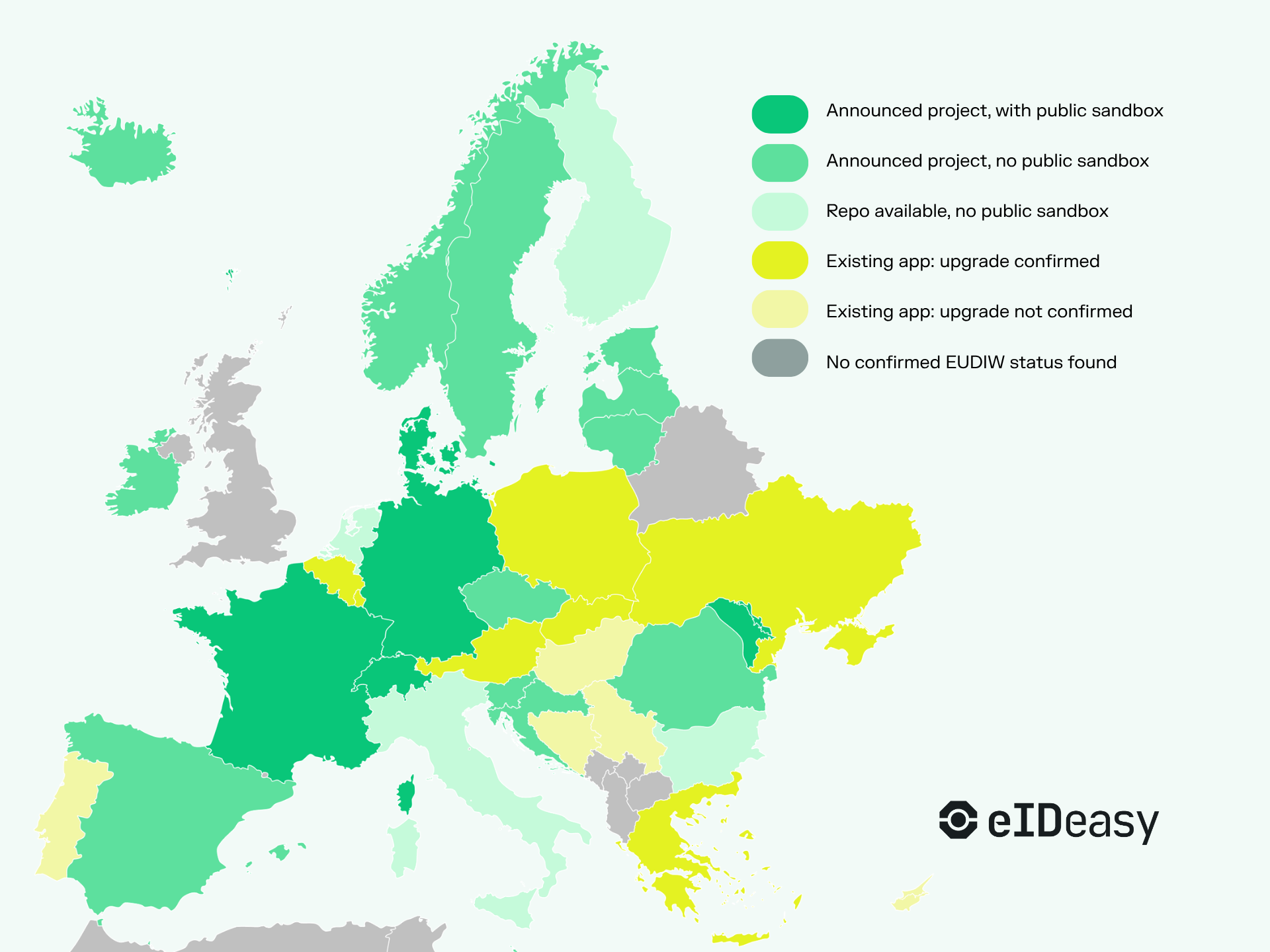
We’re continuing to track EU Digital Identity Wallet progress across Europe, including EU Member States, candidate countries, and EEA EFTA countries.
Our focus is not only whether a national wallet has been announced or launched. We are tracking how open each project is to relying parties and the wider ecosystem.
Can organisations test it? Is there a public sandbox? Are developer materials available? Is there a clear path toward integration?
That is what our categories are designed to show.
For eID Easy, this matters because we are building the eID Easy Wallet Hub to help relying parties access EU Digital Identity Wallets alongside existing national eIDs, Bank IDs, and other identity methods.
How we classify EUDIW readiness
The categories below show how open each national wallet project appears to be for external testing, technical review, and eventual integration.
|
Preparedness Definition |
|
Announced Project (with Public Sandbox)
A nationally announced EU Digital Identity Wallet implementation project with an official public sandbox or playground environment, including documentation, intended for external ecosystem testing.
|
|
Announced Project, No Public Sandbox
A publicly announced EU Digital Identity Wallet implementation project exists, but no public sandbox is available. Testing may be limited to closed pilots, beta environments, or selected participants.
|
|
Announced Project with Developer Repository
A publicly announced EU Digital Identity Wallet implementation project exists, with a publicly accessible developer repository or official developer materials, but no confirmed sandbox or beta testing environment.
|
|
Existing National Identity App Confirmed for Upgrade
An existing national identity application is in use, and the government has officially confirmed that it will be upgraded to comply with the EU Digital Identity Wallet Regulation.
|
|
Existing Identity App, Upgrade Not Yet Confirmed
An existing national identity app is in place, but no official confirmation has been found that it will be upgraded to comply with the EU Digital Identity Wallet Regulation.
|
|
No Confirmed EUDIW Status Found
No confirmed public information has been found about the country’s EU Digital Identity Wallet implementation status.
|
EUDIW status snapshot — 2 July 2026
The table below shows the latest status by country.
| Country |
Group |
National Wallet / Project |
Preparedness |
Responsible Authority |
| EU Member States |
| Austria | EU Member State | eAusweise / ID Austria | Existing app: upgrade confirmed | Federal Chancellery / Digital Austria; BRZ; BMF |
| Belgium | EU Member State | MyGov.be | Existing app: upgrade confirmed | FPS Policy and Support (BOSA) |
| Bulgaria | EU Member State | Bulgarian European Digital Identity Wallet | Announced project with dev repo | Ministry of e-Government |
| Croatia | EU Member State | National EUDIW implementation | Announced project (no public sandbox) | Ministry of Justice, Public Administration and Digital Transformation |
| Cyprus | EU Member State | IDMe.cy / National Electronic Identity | Existing app: upgrade not confirmed | Deputy Ministry of Research, Innovation and Digital Policy |
| Czechia | EU Member State | EUDIW programme / eDoklady | Announced project (no public sandbox) | Digital and Information Agency (DIA) |
| Denmark | EU Member State | AltID | Announced project (with public sandbox) | Agency for Digital Government (DIGST) |
| Estonia | EU Member State | Estonian EUDI Wallet programme | Announced project (no public sandbox) | Information System Authority (RIA) |
| Finland | EU Member State | Digital Identity Wallet / DVV wallet | Announced project with dev repo | Digital and Population Data Services Agency (DVV) |
| France | EU Member State | France Identité / EUDIW Playground | Announced project (with public sandbox) | France Identité / France Titres |
| Germany | EU Member State | State EUDI Wallet | Announced project (with public sandbox) | Federal Ministry for Digital Affairs and State Modernisation (BMDS) with SPRIND |
| Greece | EU Member State | Gov.gr Wallet | Existing app: upgrade confirmed | Ministry of Digital Governance |
| Hungary | EU Member State | DÁP app | Existing app: upgrade not confirmed | Hungarian Government / Digital Citizenship Programme |
| Ireland | EU Member State | Government Digital Wallet | Announced project (no public sandbox) | Irish Government |
| Italy | EU Member State | Sistema IT-Wallet | Announced project with dev repo | Department for Digital Transformation / PagoPA |
| Latvia | EU Member State | EU Digital Identity Wallet (Latvia) | Announced project (no public sandbox) | Ministry of Smart Administration and Regional Development |
| Lithuania | EU Member State | ES skaitmeninės tapatybės dėklė / national wallet testbed | Announced project (no public sandbox) | Informatics and Communications Department / State Digital Solutions Agency |
| Luxembourg | EU Member State | GouvID / national eWallet | Existing app: upgrade confirmed | Ministry for Digitalisation + CTIE |
| Malta | EU Member State | EU Digital Identity Wallet (Malta) | Announced project (no public sandbox) | Malta Digital Innovation Authority (MDIA) |
| Netherlands | EU Member State | NL Wallet | Announced project with dev repo | Ministry of the Interior and Kingdom Relations (BZK) |
| Poland | EU Member State | mObywatel | Existing app: upgrade confirmed | Ministry of Digital Affairs / Central IT Centre (COI) |
| Portugal | EU Member State | gov.pt app | Existing app: upgrade not confirmed | Agency for Administrative Modernisation (AMA) |
| Romania | EU Member State | Portofel European de Identitate Digitală | Announced project (no public sandbox) | DGEP / Ministry of Internal Affairs; ADR/MCID |
| Slovakia | EU Member State | eDOKLADY / eIdentita | Existing app: upgrade confirmed | Ministry of Interior |
| Slovenia | EU Member State | European digital identity wallet pilot | Announced project (no public sandbox) | Ministry of Digital Transformation |
| Spain | EU Member State | Cartera Digital / Cartera Digital Beta | Announced project (no public sandbox) | Ministry for Digital Transformation and Civil Service / SGAD |
| Sweden | EU Member State | Digital identitetsplånbok | Announced project (no public sandbox) | DIGG |
| EU Candidate Countries |
| Albania | EU Candidate Country | Albanian Digital Identity / e-Albania | No confirmed EUDIW status found | National Agency for Information Society (AKSHI) |
| Bosnia and Herzegovina | EU Candidate Country | IDDEEA Digital Identity Platform / e-IDDEEA | Existing app: upgrade not confirmed | IDDEEA |
| Georgia | EU Candidate Country | Georgian eID card / digital ID wallet POC | No confirmed EUDIW status found | Public Service Development Agency |
| Moldova | EU Candidate Country | EVO / WE BUILD EUDI Wallet pilot | Announced project (with public sandbox)* | Electronic Governance Agency (AGE) |
| Montenegro | EU Candidate Country | Electronic ID card / future mobile documents | No confirmed EUDIW status found | Ministry of Public Administration / Ministry of Interior |
| North Macedonia | EU Candidate Country | eID / reported eLI digital wallet | No confirmed EUDIW status found | Ministry of Digital Transformation / national e-services portal |
| Serbia | EU Candidate Country | National e-wallet / SERVIS | Existing app: upgrade not confirmed | Office for IT and eGovernment / eUprava |
| Türkiye | EU Candidate Country | e-Devlet / digital identity services | No confirmed EUDIW status found | Presidential Digital Transformation Office / e-Devlet |
| Ukraine | EU Candidate Country | Diia / Aptitude / POTENTIAL ecosystem | Existing app: upgrade confirmed | Ministry of Digital Transformation / Diia |
| EEA EFTA States |
| Iceland | EEA EFTA State | Digital Iceland / NOBID EUDI Wallet payments pilot | Announced project (no public sandbox) | Digital Iceland |
| Liechtenstein | EEA EFTA State | eID.li | Existing app: upgrade not confirmed | Liechtenstein National Administration |
| Norway | EEA EFTA State | NOBID / NOBCCS EUDI Wallet certification project | Announced project (no public sandbox) | Norwegian Digitalisation Agency (Digdir) |
| Switzerland |
| Switzerland | Switzerland | swiyu Wallet / Swiss e-ID | Announced project (with public sandbox)** | Federal Office of Justice / eID Admin / Swiss Confederation |
Snapshot maintained by eID Easy Provider Relations.
See something that doesn’t look right? Drop us a message and we’ll investigate.
What changed in this update?
The July 2 snapshot includes several important changes:
- EEA EFTA countries have been added to the tracker: Iceland, Liechtenstein, and Norway.
- Denmark’s AltID has launched in production.
- Ireland has been reclassified because its public pilot is citizen-facing, not a relying-party sandbox.
- Spain has been reclassified as an announced EUDI wallet project.
- Switzerland remains one of the most testable wallet ecosystems, with a legal-status caveat.
- France and Germany remain in the top category because public sandbox or playground activity is available.
Denmark: AltID is now live
Denmark is one of the clearest movers in this update.
AltID launched in production on 3 June 2026. It gives users a national digital wallet for digital ID and proofs, and provides technical information and test access for organisations.
That keeps Denmark in the top category of our tracker.
→ Important note: the current AltID Relying Party Registry is not yet an eIDAS 2.0 relying party registry. It supports national AltID use ahead of the December 2026 deadline for Member States to provide certified national wallets.
So Denmark is clearly ahead in practical wallet rollout, but the full eIDAS 2.0 relying party infrastructure is still developing.
Ireland: public pilot, but no relying-party sandbox
Ireland has launched a public pilot of its Government Digital Wallet.
That is a strong signal of progress, but the pilot is citizen-facing. We have not found a public developer or relying-party sandbox.
Because this tracker focuses on ecosystem testability, Ireland moves to Category 2: announced project, no public sandbox.
The key distinction is simple: a citizen pilot shows that users can try the wallet. A relying-party sandbox shows that organisations can test how wallet-based identity data will be requested and verified.
Spain: reclassified as an announced EUDI wallet project
Spain has moved to Category 2: announced project, no public sandbox.
In this update, Cartera Digital is treated as Spain’s EUDI wallet implementation. DNIe, eDNI, and MiDNI are treated as high-assurance identity sources, not as the wallet app itself.
This matters because national identity infrastructure and wallet implementation are connected, but they are not always the same thing.
For relying parties, the practical question is: which wallet flow will they eventually need to integrate with?
Switzerland: still highly testable
Switzerland remains in the top category because of swiyu.
The swiyu public beta gives companies, authorities, and private individuals a way to test and understand the Swiss wallet infrastructure. Public developer materials and GitHub resources are also available.
There is one important caveat: Switzerland is not part of the EEA Agreement. So this should be read as a Swiss national wallet and e-ID readiness signal, not as an EU or EEA EUDIW legal obligation.
For relying parties, the practical point still matters: Switzerland is one of the markets where wallet testing is already possible.
EEA EFTA countries added
This update adds Iceland, Liechtenstein, and Norway to the tracker.
These countries are EEA EFTA states, not EU Member States. Regulation (EU) 2024/1183 is listed by EFTA as EEA-relevant and under scrutiny for incorporation into the EEA Agreement, so we are tracking them separately from the EU-27.
Current classification:
Iceland — Category 2
Announced project / pilot activity, but no public relying-party sandbox found.
Norway — Category 2
Active in Nordic-Baltic EUDI wallet certification and pilot-related work, but no public national relying-party sandbox found.
Liechtenstein — Category 5
Live national eID app, but no confirmed upgrade to an EUDI wallet implementation found.
France and Germany remain in Category 1
France and Germany remain in the top category because public sandbox or playground activity is available for external ecosystem testing.
France Identité is already live as a national identity app, but it is not yet certified as an EUDI wallet.
Germany remains in Category 1 with its State EUDI Wallet project and sandbox activity ahead of its staged public rollout, currently expected in early 2027.
For relying parties, both markets remain highly relevant to watch and test against now.
What this means for relying parties
The July snapshot shows that EUDIW rollout is becoming more visible, but still uneven.
Some countries have public sandboxes. Some have production national wallet apps. Some have citizen pilots. Some have developer repositories or technical materials. Others still have little public information available.
So the question is not only: “Which countries have a wallet?”
The more useful question is: “Which countries are open enough for relying parties to test, understand, and prepare?”
That is what this tracker is built to answer.
eID Easy's Role
Today, we already connect organisations to national eIDs and bank-based identity schemes across Europe. As EU Digital Identity Wallets become available in each country, they will be added alongside those existing methods.
One integration. Multiple identity methods.
→ Interested in current national eIDs, Bank IDs, and, as they launch, EU Digital Identity Wallets? Let's have a chat or send us a message.