We’re continuing to track EU Digital Identity Wallet progress across Europe, including EU Member States, candidate countries, EEA EFTA states, and Switzerland.
As before, we’re not only looking at whether a country has announced a wallet. That part alone doesn’t tell relying parties much.
The more useful question is: can organisations actually do something with it yet?
Can they test it? Can they access a sandbox? Are developer materials available? Is there a clear path toward integration?
That is what our tracker is designed to show.
For eID Easy, this matters because we’re building the eID Easy Wallet Hub to help relying parties access EU Digital Identity Wallets alongside the national eIDs, Bank IDs, and identity methods they already use today.
We’re continuing to track EU Digital Identity Wallet progress across Europe, including EU Member States, candidate countries, EEA EFTA states, and Switzerland.
And this is not just something we’re tracking from the outside. eID Easy also has a EUDIW playground where teams can already try wallet flows in practice, including German, French, Danish, and private wallet environments. The playground currently supports two flows: an OAuth redirect flow and a QR code flow, so teams can test how wallet-based identity data could be requested and returned.
How we classify EUDIW readiness
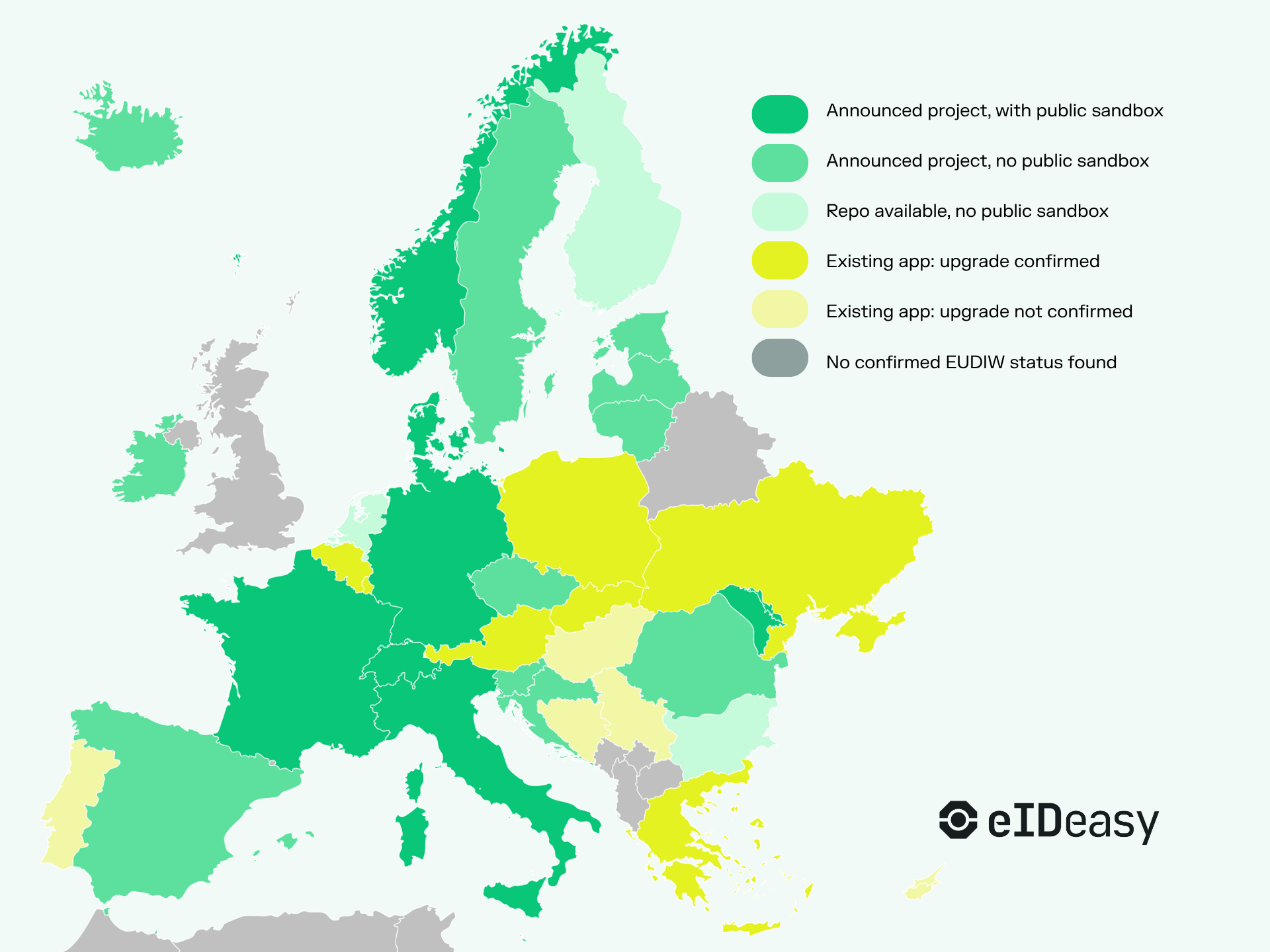
The categories below show how open each national wallet project appears to be for external testing, technical review, and eventual integration.
EUDIW status snapshot — 3 August 2026
The table below shows the latest status by country.
This update is based on the latest tracker refresh completed on 3 August 2026.
Snapshot maintained by eID Easy Provider Relations.
See something that doesn’t look right? Drop us a message and we’ll investigate.
What changed in this update?
This is not one of those months where the whole map changes.
Most countries remain in the same category as before. The main category changes this month are Italy and Norway.
Italy moves from Category 3 to Category 1
Italy has moved from Category 3 to Category 1: The reason is that the Italian government opened a controlled national IT-Wallet test environment to private wallet providers in May 2026. That is a meaningful step.
Previously, Italy sat in the category for countries with an announced project and public developer materials, but no confirmed sandbox or test environment. With this update, Italy is no longer only in the “developer documentation is available” stage.
There is now controlled testing around the national IT-Wallet.
Norway moves from Category 2 to Category 1
Norway has moved from Category 2 to Category 1.
We added EEA for the first time last month, and based on further research we moving Norway into the top category because Digdir now has a public national sandbox for digital wallets, with test infrastructure for public and private actors.
The important point here is testability. Norway does not need to be treated in exactly the same way as an EU Member State, and because EEA has a slightly longer implementation deadline. But from a practical relying party perspective, Norway now has a public sandbox environment that makes it possible to understand and test wallet-related flows.
Sweden publishes a clearer wallet roadmap
Sweden stays in Category 2, but we're sharing the news that they have published a clearer wallet roadmap.
DIGG has published a phased roadmap for Sweden’s digital identity wallet. The current plan points to a first state-wallet version, Sverige-ID, and an ecosystem test environment in December 2026.
After that, the roadmap points to attribute certificates and more features from 2027, a certification-ready EUDI Wallet in 2028, and a certified EUDI Wallet in 2029.
This gives relying parties, attribute issuers, and identity teams a clearer view of what to expect.
For now, Sweden stays in Category 2 because there is no public external sandbox available yet. But when available we expect to see the Sverige-ID available via the Sweden Connect national node.
What this tells us
The August snapshot confirms the pattern we’ve been seeing for months: EUDIW progress is real, but practical availability still depends heavily on the country.
Some countries are already testable through public sandboxes or playgrounds. Others are working through controlled pilots, procurement, registries, certification, or phased roadmaps.
Those details matter.
A public roadmap is useful, but it is not the same as a sandbox.
A controlled test environment is useful, but it is not the same as open relying party access.
A production national wallet app is useful, but it may still not mean the full eIDAS 2.0 relying party setup is ready.
For businesses, the important question is not only:
“Has this country announced a wallet?”
It is:
“Can we test it, integrate with it, or plan around it in a practical way?”
That is the question this tracker is meant to answer.
Why this still matters
The EU Digital Identity Wallet rollout will not happen in one clean moment.
Different countries are moving at different speeds, and the signals are not always easy to compare. One country may publish developer materials. Another may open a controlled pilot. Another may launch a national wallet app, but without public relying party access yet.
For relying parties, that makes it hard to know where to focus first.
Our goal with this tracker is to give a practical view of where wallet projects are becoming accessible enough to test, understand, and eventually integrate — including what may become available through the eID Easy Wallet Hub.
eID Easy’s role
Today, eID Easy already connects organisations to national eIDs and bank-based identity schemes across Europe.
As EU Digital Identity Wallets become available in each country, they will be added alongside those existing methods under one API.
One integration. Multiple identity methods.
Interested in current national eIDs, Bank IDs, and, as they launch, EU Digital Identity Wallets? Let’s have a chat or send us a message.