Actualización de la empresa, enero de 2026: un breve resumen de lo que hemos creado, lo que está por venir y quiénes lo están dando forma.
Más información
Verify users using trusted digital identities for onboarding, authentication, and compliance.
Replace or complement document-based checks with national and bank eIDs today, and prepare for EU Digital Identity Wallets (EUDIW) as they launch.
Most identity verification today relies on document scans and manual or automated checks. It adds friction and doesn’t scale well across markets. Using trusted digital identities allows you to verify users faster, with higher assurance, and without rebuilding your existing flows.


Support identity methods aligned with European standards for electronic identification and trust services, including high-assurance identity verification across the EU.

Comply with payment security requirements. Protect users and transactions with multi-factor authentication.

Safeguard personal data and privacy. Ensure identity data is processed in line with GDPR principles.

The user signs up, logs in, or performs a sensitive action in your app or platform.
They select from available bank or national identity options.
(Wallet-based identity methods can be added as they become available.)
They follow familiar steps in their banking or national ID app.
The verification result is returned instantly, and the user continues without document uploads.

Use eID authentication today and extend the same flows with European Digital Identity Wallets (EUDIW) as they become available.

Combine eID-based authentication with eSignatures and eSeals to support end-to-end, legally valid fintech workflows.

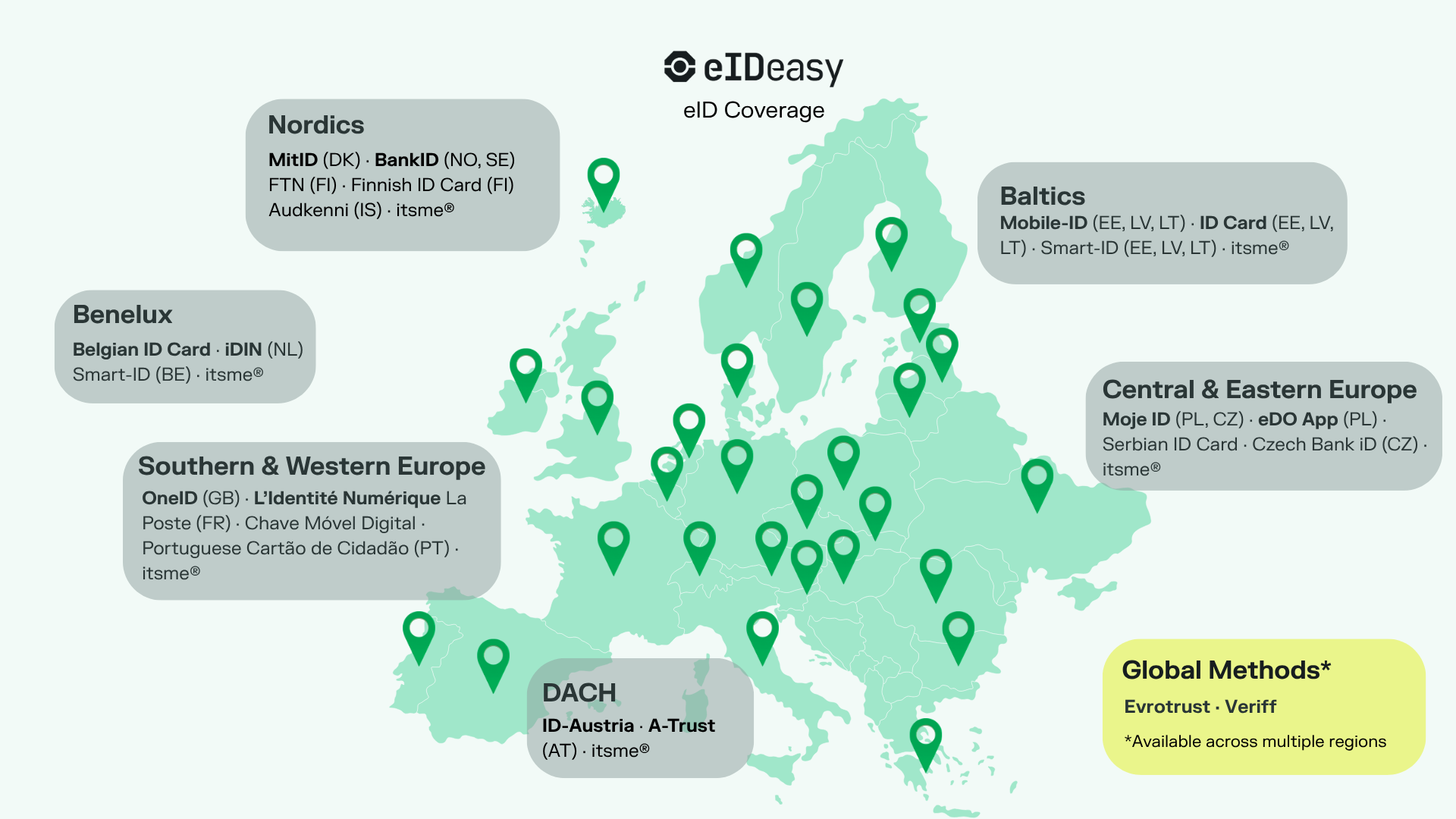
Access a wide range of trusted national eID and bank-based identity providers.

Avoid integrating multiple identity providers market by market.

Replace document uploads with familiar identity methods users already trust, improving onboarding completion.
Traditional KYC and IDV rely on document scans and manual or automated reviews to verify identity, typically as a one-time check during onboarding. eID authentication uses pre-verified, trusted electronic identities, removing the need for document uploads and enabling reusable identity for onboarding and ongoing access. eID Easy connects multiple eID providers through a single API, continuously expanding coverage and preparing the same flows for European Digital Identity Wallets (EUDIW) as they launch.
eID authentication is widely used today with existing national and bank-based eID schemes. European Digital Identity Wallets (EUDIW) will extend this model, and fintechs can prepare now by using wallet-ready identity platforms, like eID Easy.
Yes. eID Easy is designed to complement existing KYC or identity verification solutions by adding trusted eID methods alongside document-based checks.