By late 2027, the EU Digital Identity Wallet (EUDIW) is expected to move from policy documents and pilot projects into everyday operational reality for many organisations across Europe, as Member State wallets and relying‑party obligations phase in.
For a growing group of service providers, accepting the EUDI Wallet as a way for users to identify and authenticate themselves will no longer be a “nice to have” but a regulatory expectation in many regulated and high‑trust digital environments.
What’s changing in 2027: in simple terms
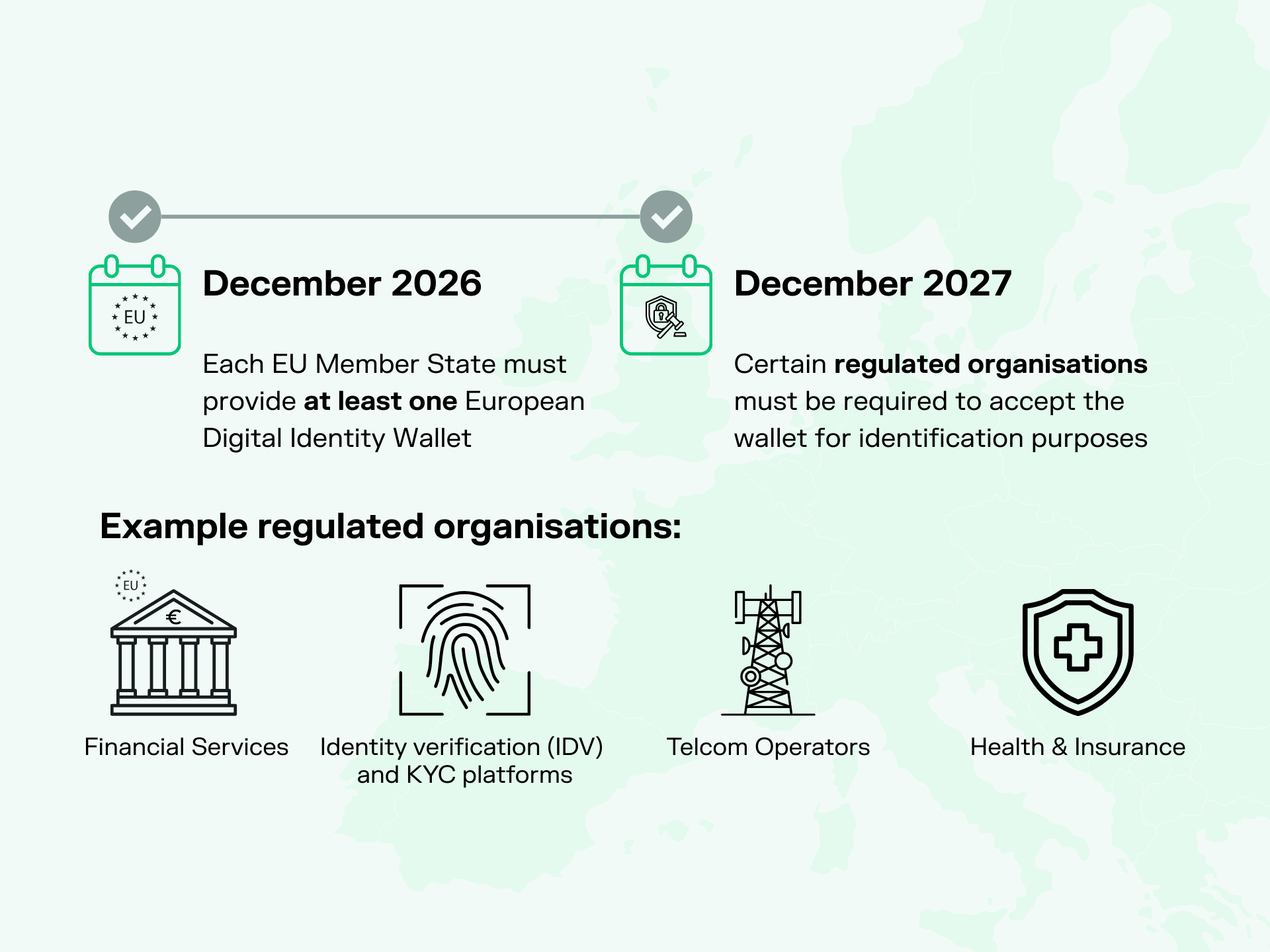
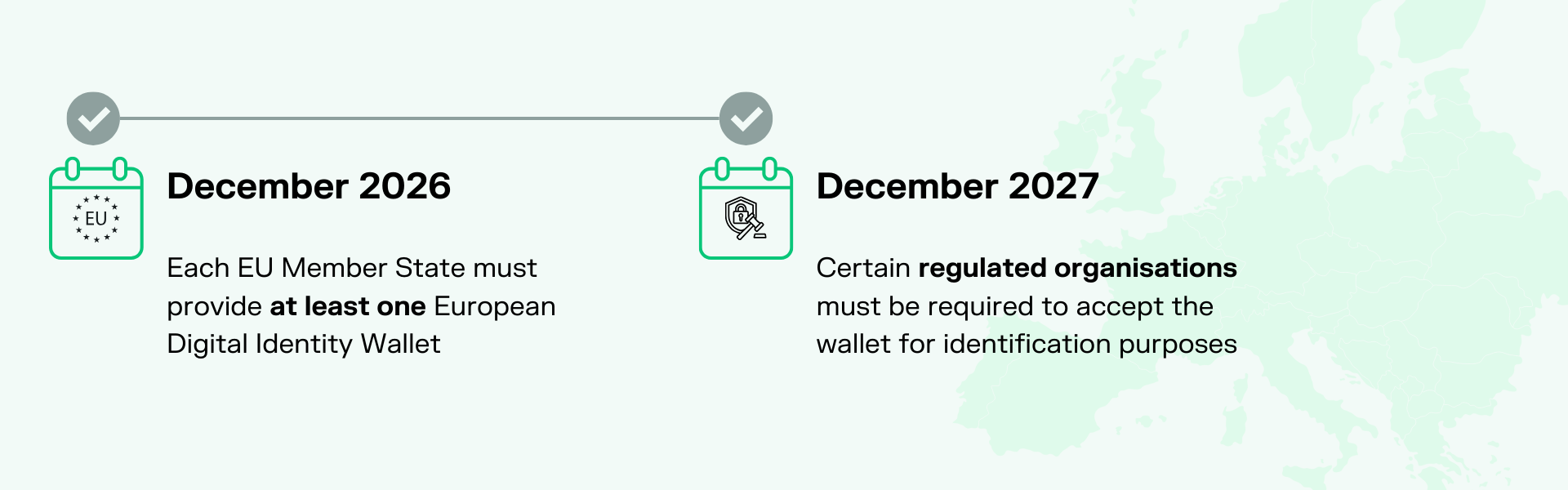
Under the updated eIDAS Regulation (eIDAS 2.0), EU Member States must first make digital identity wallets available to users by the end of 2026. One year later, certain organisations (listed below) will be required to accept those wallets when identity verification or authentication is legally required.
This doesn’t mean every business suddenly has to switch to wallets only or stop offering other login and KYC methods.
→ It means that, for defined sectors and services where identification or strong authentication is already required by law or contract, the EUDI Wallet must be accepted as a valid option once the obligations apply, typically on the voluntary request of the user.
In practice, many organisations will find themselves acting as relying parties for the wallet ecosystem, whether they explicitly planned for that role or not.
What does “relying party” mean here?
In the EUDI context, a relying party is an organisation that relies on electronic identification or credentials issued by someone else to identify a user or verify their attributes.
With the EU Digital Identity Wallet:
- the issuer is typically a government or trusted authority(such as a qualified trust service provider)
- the user holds their identity or attributes in their wallet,
- the relying party is the organisation that accepts those credentials to let the user onboard, log in, or access a service.
So if your organisation accepts identity information from a wallet, you are acting as a relying party, even if identity is not your core business.
A concrete example: a telecom provider
- Today:
A customer may upload an ID document, visit a shop with a physical ID, or use a national eID scheme to register a SIM.
- From the late‑2027 phase of the EUDI framework (once the relevant national wallet and obligations are in force):
A customer could present their identity and age through their EUDI Wallet instead of, or in addition to, those existing methods, where national implementation allows this.
At that moment:
- the telecom provider is relying on a credential issued by a trusted authority,
- they must trust its validityin line with eIDAS 2.0
- they must process it correctly and compliantly.
→ That’s what “acting as a relying party” means; whether the telecom set out to become one or not.
Is your organisation affected?
A practical way to understand who is affected is to look at Strong Customer Authentication (SCA) and other strong‑identity obligations.
SCA has been mandatory across the EU and EEA since 2021 under the Second Payment Services Directive (PSD2). Any business that must apply SCA today is already operating in a regulatory environment where strong, reliable identity checks are required.
Those organisations are also among the most likely to fall within the scope of mandatory EUDI Wallet acceptance from 2027.
"Certain organisations" in question
EUDIW affects services where identity is essential for access, compliance, or trust. That includes a wide range of regulated and semi-regulated sectors.
Core regulated sectors
Banking and financial services
Account opening, payments, customer authentication, and ongoing KYC.
Telecommunications
SIM registration, customer identification, and account access.
Energy and utilities
Identity verification for contracts, switching providers, and regulated services.
Public and social security services
Access to benefits, entitlements, and official digital services.
Healthcare
Identity and eligibility checks for access to health-related services, where applicable.
Often overlooked but highly relevant use cases
Beyond the obvious sectors, wallet-based identity also shows up in many less talked-about, but operationally important scenarios:
- Education platforms issuing or verifying degrees, diplomas, or student status
- Professional services verifying licences or regulated professional status
- Transport subscriptions requiring identity-linked access rights
- Postal and delivery services handling identity-sensitive deliveries
- Digital infrastructure providers granting access to regulated platforms or systems
- Employment and right-to-work checks, especially in cross-border contexts
These use cases rely heavily on verified attributes (such as age, residence, qualification, or mandate) rather than full identity documents, which is a core design principle of the EUDI Wallet.
Very large online platforms are also in scope
Beyond traditional regulated industries, very large online platforms are also part of the picture.
Marketplaces, app stores, major search engines, social media platforms, and large digital content services are expected to support EUDI Wallet–based identification and authentication where required.
For organisations operating at this scale, EUDIW is closely linked to:
- platform trust,
- user authentication,
- and regulatory accountability.
Why preparation matters now
Two years may sound like a long time. In reality, for organisations with:
- complex onboarding journeys,
- multiple markets,
- long procurement cycles,
- or outsourced identity operations,
waiting is risky.
Wallet-based identity will not arrive everywhere at once. It will roll out country by country, wallet by wallet, as Member States implement the framework and issuers and relying parties come online. Organisations that prepare early can integrate wallets as a natural extension of existing identity flows (rather than being forced into rushed, fragmented implementations later).
Can eID Easy help?
Of course! :) And without making things more complicated than they need to be.
eID Easy helps organisations adopt trusted digital identity without rebuilding existing onboarding flows.
Today, eID Easy already connects businesses to national and bank-based electronic identity methods across Europe through a single integration. These include widely used eID schemes issued by governments and banks across multiple EU and EEA countries.
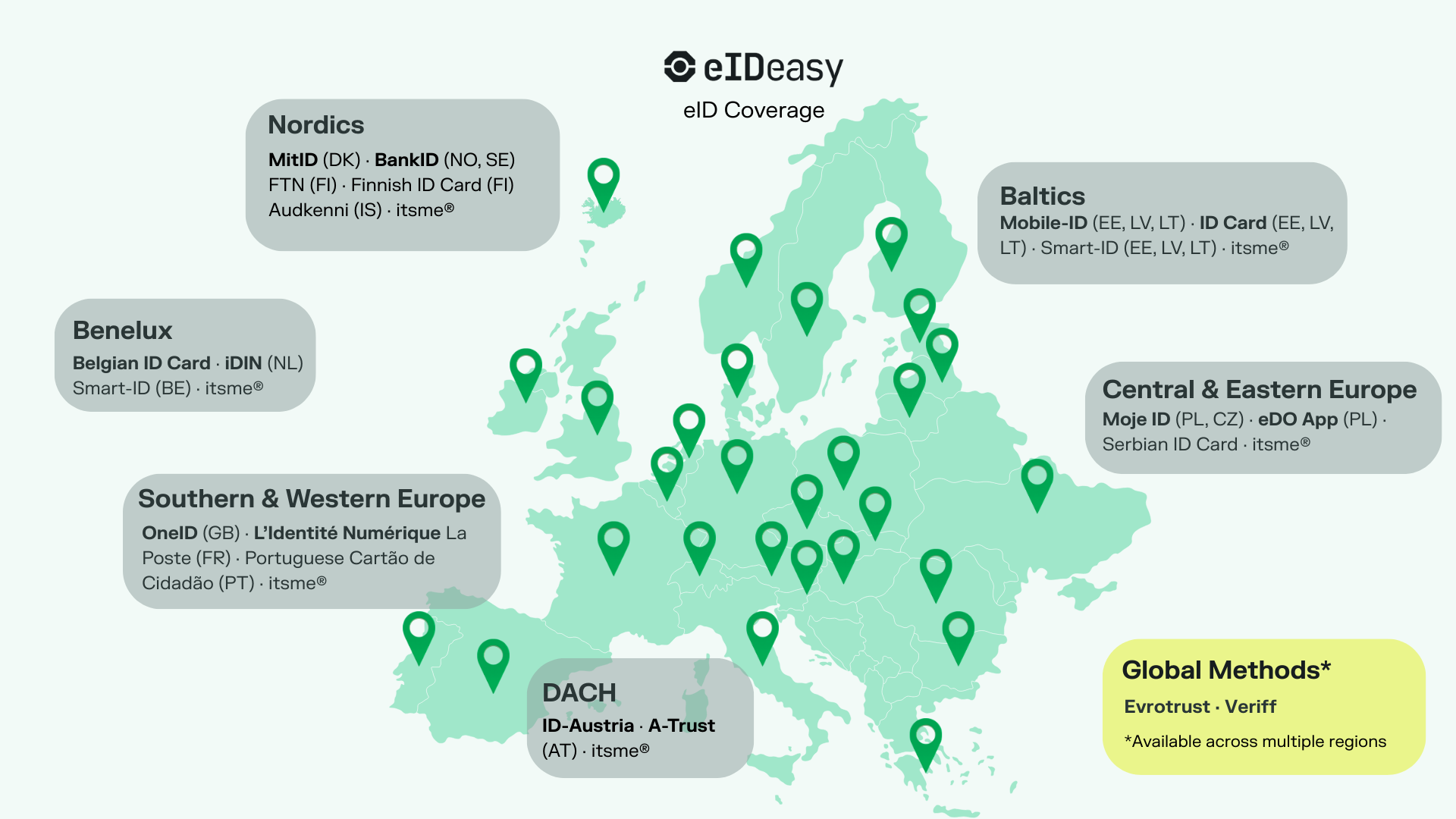
As the EU Digital Identity Wallets are launched country by country, wallet support is added alongside existing eID methods, using the same aggregation layer.
In practice, this means:
- Use trusted national and bank-based eIDs today
- Add EUDI Wallet support as wallets become available
- Avoid fragmented, country-by-country integrations
- Keep one technical and commercial connection
- Integrate wallet-based identity as an extension, not a replacement
→ eID Easy acts as an identity aggregation layer, helping organisations and service providers support wallet-based identity now, and as the ecosystem evolves.