The EU’s move from paper Certificates of Conformity to electronic Certificates of Conformity is still very much happening.
But there is now more breathing room.
The original eCoC deadline was 5 July 2026. From that date, vehicle manufacturers were expected to make Certificates of Conformity available as structured electronic data, instead of relying on paper documents.
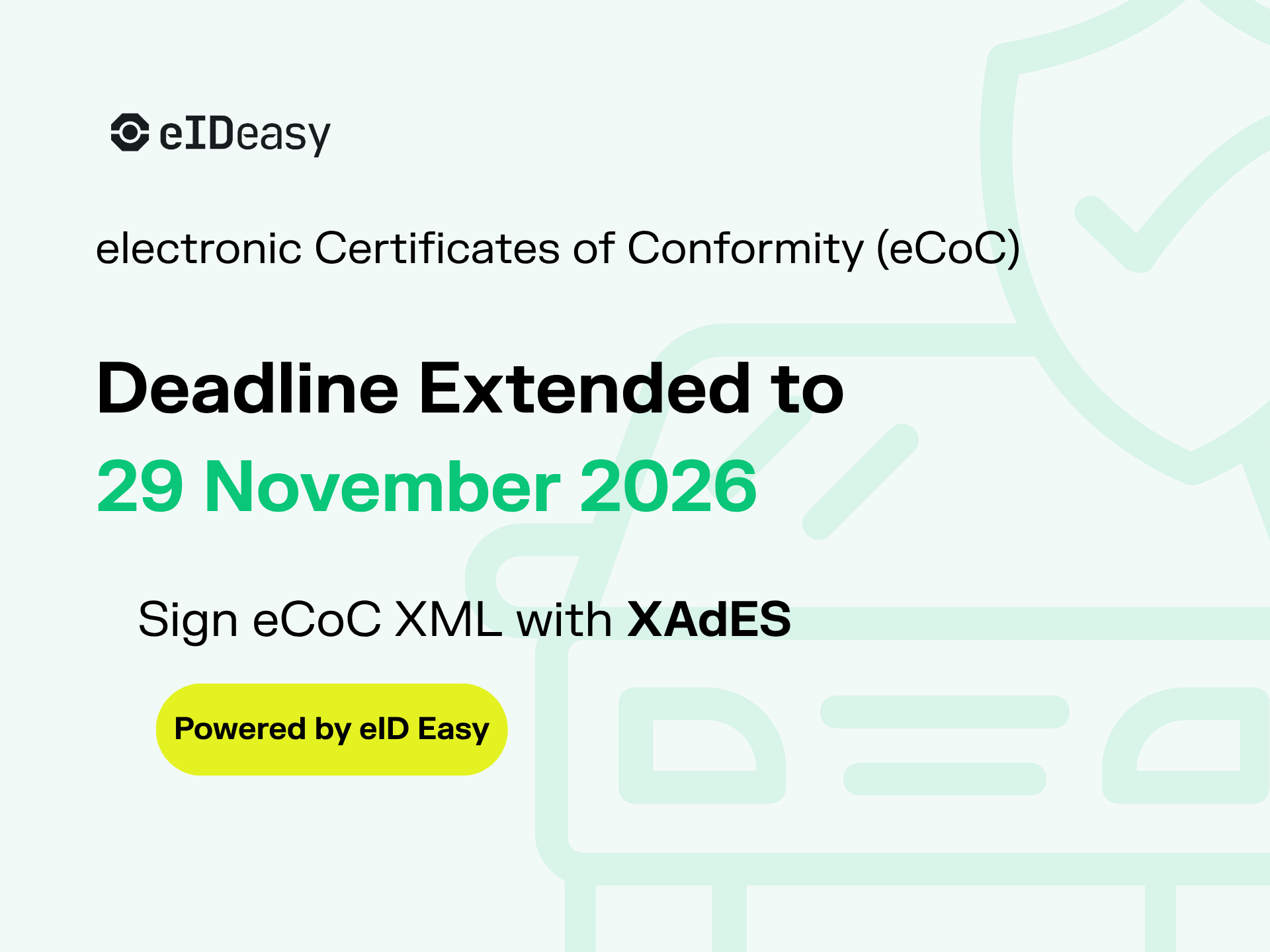
Following recent discussions around EU implementation readiness, a transitional arrangement has now been reported for jurisdictions where the required National Access Point infrastructure is not ready in time. Under this arrangement, manufacturers may continue using paper Certificates of Conformity or signed and stamped eCoC print-outs until 29 November 2026 at the latest.
That means the new practical backstop date is:
29 November 2026
What Changed?
The EU eCoC transition depends on several moving parts:
- vehicle manufacturers generating structured XML eCoC data;
- national authorities being ready to receive and process that data;
- National Access Points being available for secure data exchange;
- eCoC data being signed correctly; and
- systems being tested before high-volume production use.
The original date, 5 July 2026, remains important. It is the date set out in the EU type-approval framework for the shift toward structured electronic Certificates of Conformity.
However, not every national system appears to be fully ready at the same pace. The reported transitional arrangement gives some Member States and manufacturers more time to keep vehicle registrations moving while the electronic infrastructure is completed.
The latest reported cut-off is 29 November 2026.
After that, manufacturers should expect the eCoC process to be fully electronic.
What Is an eCoC?
An eCoC, or electronic Certificate of Conformity, is the digital version of the traditional paper CoC issued by a vehicle manufacturer.
It confirms that an individual vehicle has been produced in conformity with an approved type and meets the relevant regulatory requirements.
The difference is that an eCoC is not just a scanned PDF.
It is structured data, usually in XML format, designed to be read, validated, exchanged, and stored automatically by digital systems.
That matters because vehicle registration authorities across Europe need reliable, machine-readable data they can process without manual retyping, mailing, or document handling.
Why XML Matters
The EU eCoC framework is built around structured vehicle data.
XML is used because it allows vehicle information to be exchanged in a predictable, machine-readable format. This makes it easier for authorities to:
- validate vehicle data automatically;
- reduce manual data-entry errors;
- support cross-border vehicle registration;
- store data consistently; and
- retrieve vehicle information later when needed.
But XML alone is not enough.
The eCoC must also be digitally signed or sealed so the receiving authority can verify where it came from and confirm that the data has not been changed.
Why Digital Signatures and Seals Matter
An eCoC is a compliance document. It needs trust.
That means the digital signature or electronic seal must prove:
- who issued the eCoC;
- that the issuer is linked to a verified identity;
- that the data has not been tampered with;
- that the signature or seal can be validated later; and
- that the document can be trusted across borders.
For XML-based eCoC files, the relevant signature format is XAdES, short for XML Advanced Electronic Signatures.
XAdES is designed for signing XML data directly. It supports long-term validation and can be used for advanced or qualified electronic signatures and seals under eIDAS.
For manufacturers, this usually means choosing between:
- Advanced Electronic Signatures;
- Qualified Electronic Signatures;
- Advanced Electronic Seals; or
- Qualified Electronic Seals.
The right choice depends on your workflow, your national authority, and whether the document should be signed by a person or sealed by an organisation.
What Does the New Deadline Mean for Manufacturers?
The new 29 November 2026 date gives manufacturers more time, but not much.
If you still need to implement eCoC signing, this is the time to act.
A compliant eCoC setup is not just a button that signs a file. You may need to:
- generate the correct XML structure;
- validate XML against the relevant schema;
- choose the correct XAdES signature structure;
- connect to a Qualified Trust Service Provider if qualified signatures or seals are needed;
- test the signature validation process;
- integrate signing into your production or registration workflow;
- prepare for different national access point requirements; and
- support fallback paper or print-out processes during the transition period.
In other words, the extension gives you time to implement properly.
It does not mean you should wait until November.
eID Easy Helps You Implement eCoC Signing
At eID Easy, we help vehicle manufacturers, software providers, and system integrators implement compliant digital signing for XML-based eCoC workflows.
We provide the digital trust layer for eCoC, including:
- XAdES signatures for XML-based eCoC files;
- Advanced Electronic Signatures and Seals;
- Qualified Electronic Signatures and Seals;
- integration with Qualified Trust Service Providers;
- support for organisation-based electronic seals;
- support for person-based electronic signatures;
- long-term validation options;
- API-based signing workflows; and
- help choosing the right signature or seal level for your use case.
You do not need to build the full digital signature infrastructure yourself.
We already work with identity-based signatures, seals, QTSP integrations, and XML signature formats. eCoC is exactly the kind of structured, compliance-driven use case where eID Easy can help.
You Still Have Time, But the Window Is Closing
The new practical deadline gives manufacturers more room to prepare.
But implementation still takes planning, testing, and validation.
If your eCoC process is not ready yet, now is the right moment to speak with a specialist and map out what you need before the final cut-off.
Whether you need XAdES signing, qualified electronic seals, advanced signatures, or help understanding which setup applies to your eCoC workflow, eID Easy can help you move faster.
Talk to an eCoC Expert
Need help signing XML-based eCoC files?

We’ll help you understand what signature or seal level you need, how to integrate XAdES into your workflow, and how to get ready before the 29 November 2026 backstop date.
Read More
→ Developer Guide for XML-Based Digital Signatures
→ Advanced and Qualified XML-Based Signatures from eID Easy
→ What Is an Electronic Certificate of Conformity?
→ XAdES for eCoC: What Manufacturers Need to Know