Across Europe, governments are actively working on implementing the EU Digital Identity Wallet Regulation. But their public statements can be harder to read.
Some countries, like France and Germany, already have mature digital identity projects and are building ecosystems on top of them in a very public way. Others are still developing foundational infrastructure.
Some are privately piloting, away from the public eye. And some are yet to confirm whether existing national wallet apps will become the future EUDIW app.
Tracking this landscape is something John Jolliffe, our Provider Relationship Manager at eID Easy, is doing daily.
As he puts it:
“All across Europe, governments are working hard on implementing the EU Digital Identity Wallet Regulation. But countries are starting from very different places and following very different approaches.
Tracking how the different projects are evolving is not easy, as not every country is so forthcoming about their plans. But it’s part of what we do every day to ensure we can offer customers access. Not just to the technology, but to the use cases they enable and the , problems they can solve.”
Snapshot: EUDIW Member State Implementation Status
With most countries still publicly holding the line that they will meet the EU’s deadline of December 2026 to deliver a first working EUDIW implementation, assessing preparedness can be tricky.
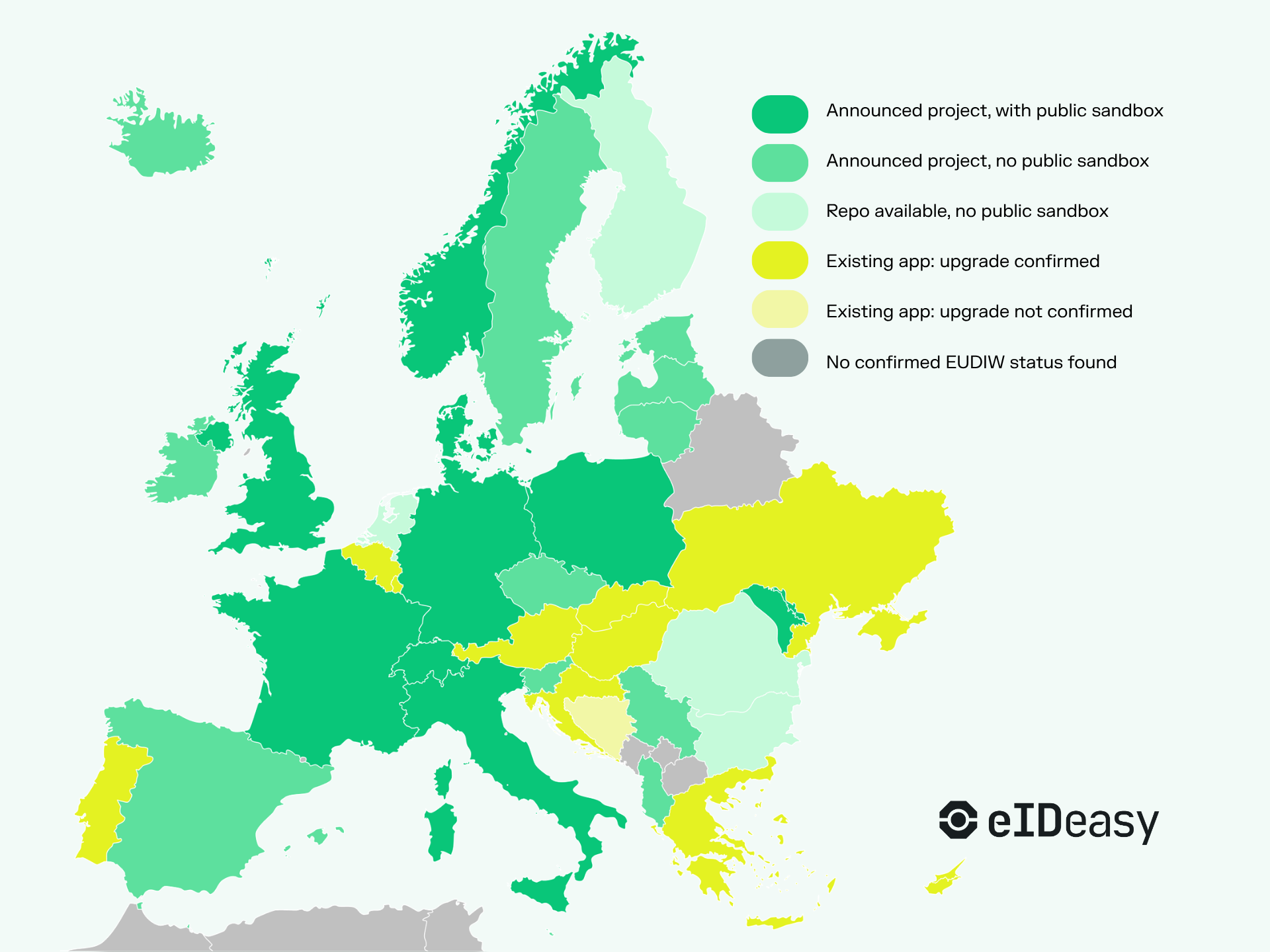
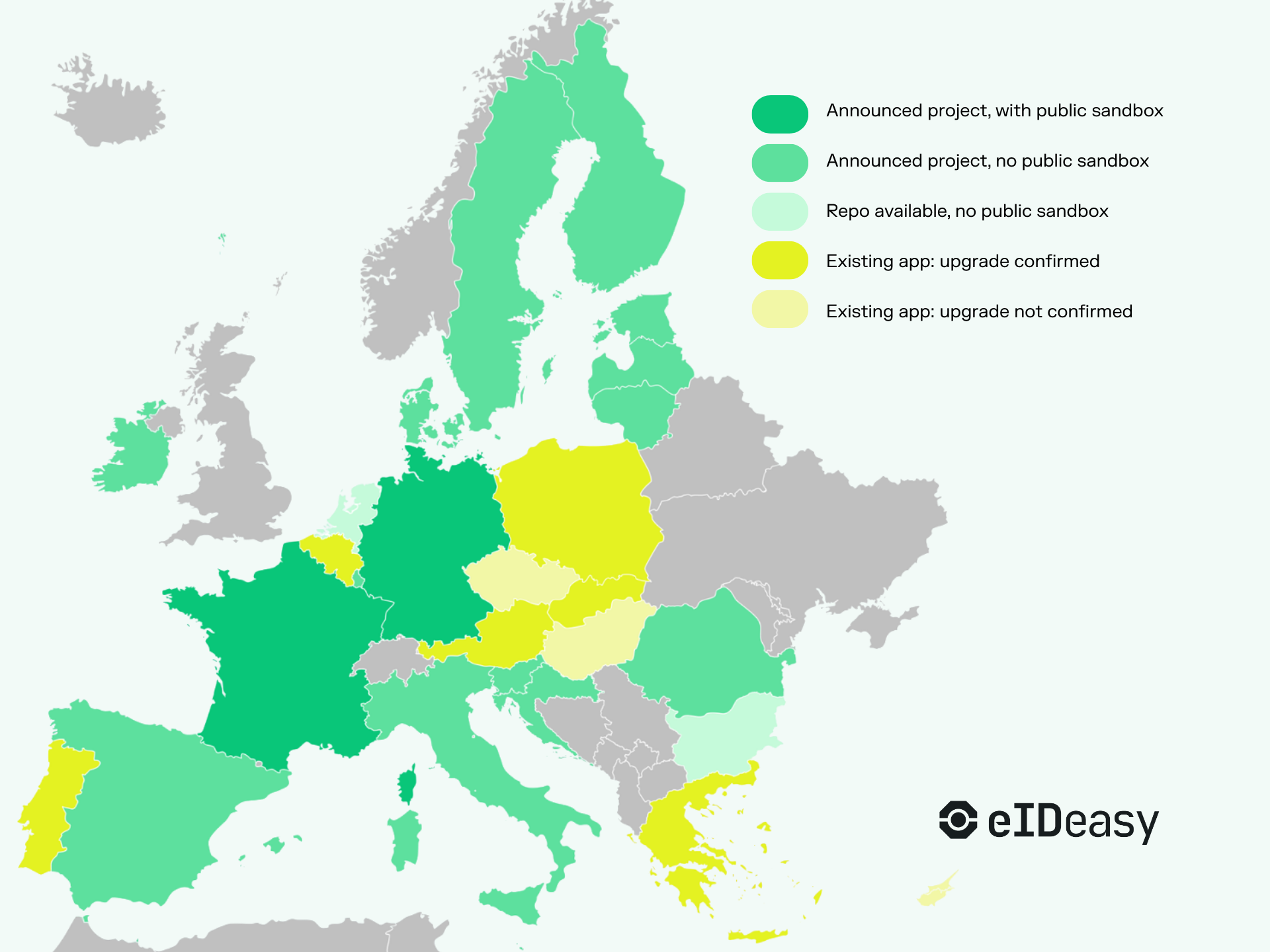
So we’ve used a range of publicly available information sources - announcements, speeches, presentations, even developer resources - to come up with a sense of how far advanced the different countries are.
The results are shown in the table below, which gives a state of play as of 27 February 2026.
Preparedness Levels Explained:
→ Snapshot maintained by eID Easy Provider Relations.
See something that doesn't look right? Drop us a message and we'll investigate.
Top 5 Countries to Launch First?
As soon as John shared the table with me , I did what any marketer would do.
I asked him for a hot take: “Top five countries to launch first. Go.”
Apparently, when we talk about who will launch first, it gets complicated.
“Launch is a tricky concept,” John said.
Some countries have already released wallet applications. France, Germany, Belgium, Austria, they have something live in users’ hands today that is set to become a full implementation.
But those apps are not static products. They are being continuously upgraded and extended to meet different parts of the EU Digital Identity Wallet framework.
In other words, “live” doesn’t always mean “fully compliant”.
And “not launched” doesn’t always mean “not progressing fast”.
That’s why ranking countries is harder than it sounds.
Still, if we look at where operational apps exist today, and where strong national eID foundations are already in place, four clear frontrunners stand out:
• France and Germany have the most visible engagement with the developer community and the ecosystem of relying parties.
• Italy is working hard on its Sistema IT offering, building on years of experience with the widely adopted SPID national eID
• Austria already has a successful, widely adopted national ID scheme and wallet which is on track to become the national EUDIW
These countries are not starting from scratch. They are building on mature national eID schemes and extending them toward full EU Digital Identity Wallet compliance.
That gives them a structural advantage.
→ But progress across Europe is uneven, and evolving month by month. What looks like a lead today may shift quickly as other Member States move from pilot to production.
Who’ll Take the Lead on Adoption?
“Launching” is one thing. Adoption is another.
According to John:
“It will be a combination of demographic factors and usability of the services. Larger countries always struggle to drive widespread adoption. So I would expect a smaller nation like Austria or Belgium, which both have strong eID schemes currently, to have the strongest uptake.”
Our CEO, Maoiliosa O'Culachain also pointed out that wallet adoption will depend heavily on use cases:
“If everything works smoothly but there are few meaningful reasons to use the wallet, uptake will likely remain slow. On the other hand, a single compelling use case can accelerate adoption dramatically (even if trust levels are still forming or the UX is not perfect).
“We’ve seen this before... In one country, a regulatory change created a clear, nationwide need for verified identity, and user numbers grew to around 10 million in a short period of time. A strong compliance-driven use case can shift adoption almost overnight.”
Shortly, wallet success will depend on:
- The strength and urgency of real-world use cases, including regulatory triggers
- Existing trust in national eID systems
- Ease of use and clarity of the user journey
- Integration into services people already use
- Country size and overall digital maturity
Why This Matters
For organisations operating across borders, the EU Digital Identity Wallet rollout will not happen in one single moment.
It will be gradual. Country by country. Use case by use case.
Understanding where each Member State stands helps answer practical questions:
- Where should we prioritise integration?
- Which markets are ready for wallet-based onboarding?
- Where will adoption likely come fastest?
- Where are we still looking at infrastructure build-out?
eID Easy's Role
That visibility is part of what we track continuously at eID Easy.
Today, we already connect organisations to national eIDs and bank-based identity schemes across Europe. As EU Digital Identity Wallets become available in each country, they will be added alongside those existing methods.
One integration. Multiple identity methods.
→ Interested in current national eIDs, Bank IDs, and, as they launch, EU Digital Identity Wallets? Let's have a chat or send us a message.