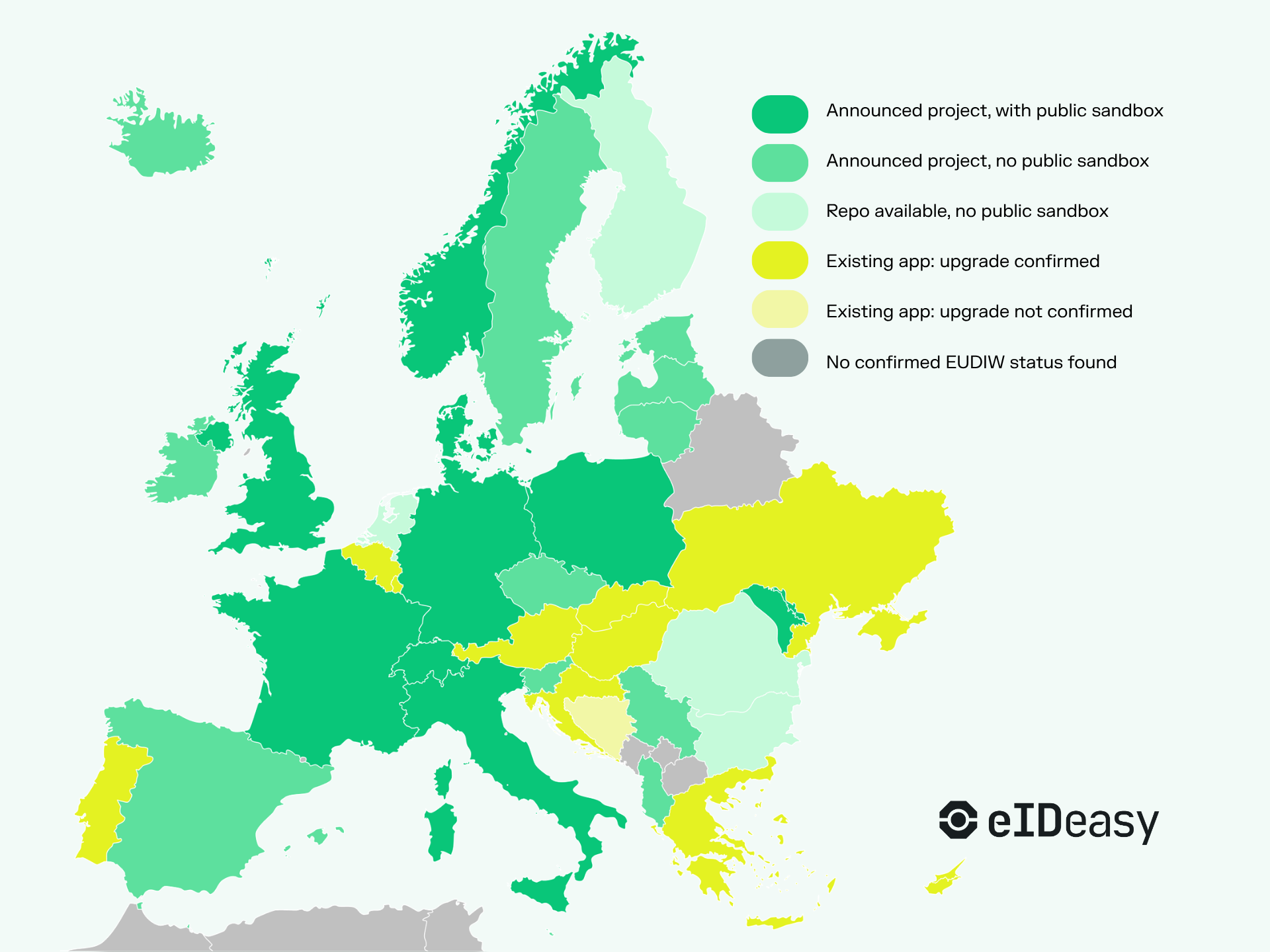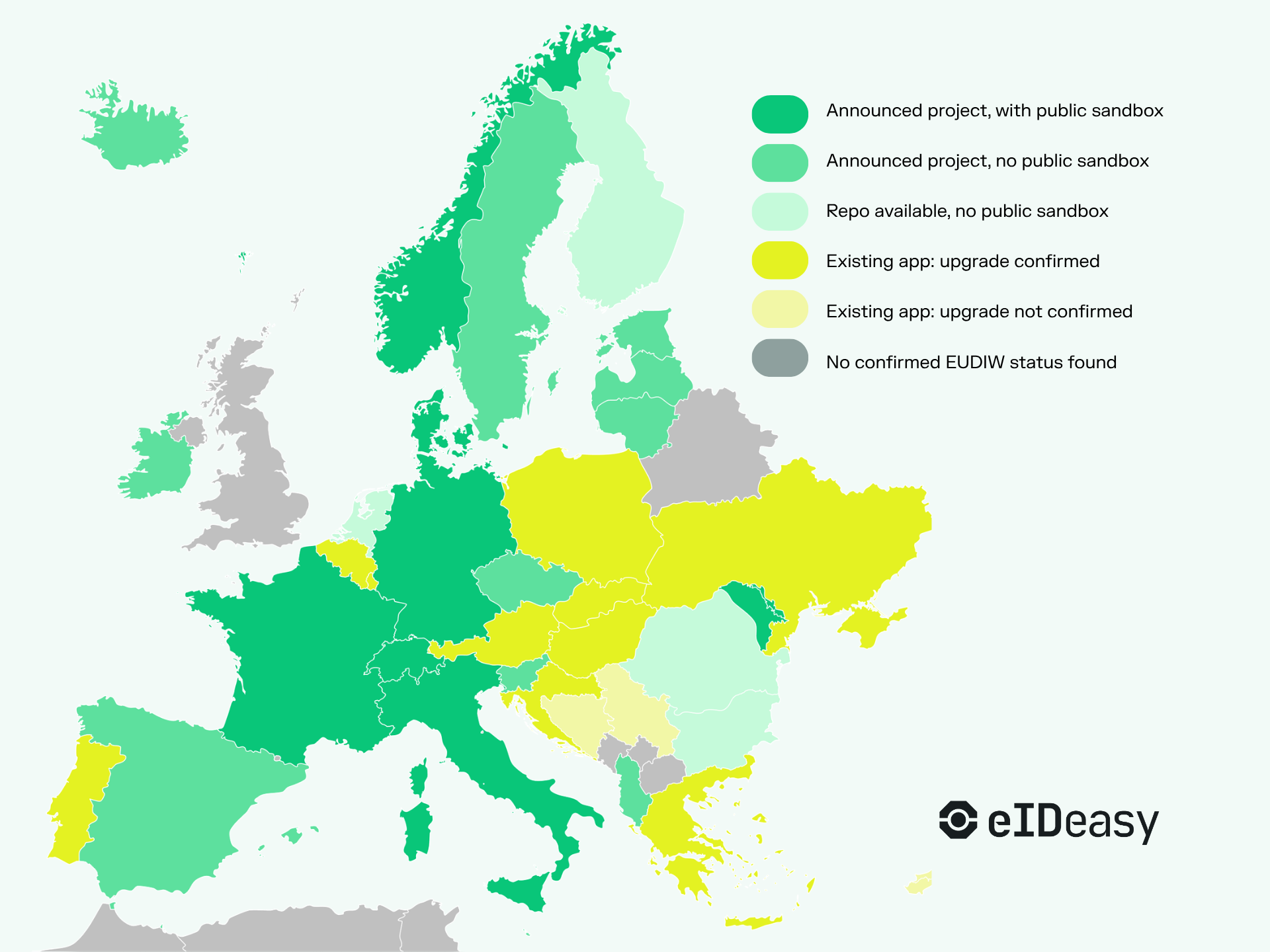
We’re continuing to track EU Digital Identity Wallet readiness across EU Member States, candidate countries, EEA EFTA states, and Switzerland.
For this tracker, the question is practical:
Can relying parties actually do something with the wallet yet?
That means we look at public sandboxes, developer documentation, confirmed national wallet apps, relying party access, and clear implementation signals.
What changed in this update?
The main update this month is Romania.
Romania moves to Category 3 after launching RO Wallet materials and publishing technical documentation on GitHub. The Romanian Ministry of Internal Affairs announced that the RO Wallet website is live and that technical documentation is available publicly through the rowallet-documentation and rowallet-pid GitHub projects.
Other notable changes:
- Croatia moves to Category 4 because Certilia Wallet is confirmed as EU Wallet ready and the basis for Croatia’s national EUDI Wallet.
- Hungary moves to Category 4 as the DÁP app / Digitális Adattárca path becomes clearer.
- Portugal moves to Category 4 as the gov.pt app is now more clearly tied to Portugal’s EUDI Wallet implementation.
- Finland stays in Category 3, but now has Scytáles confirmed as technical implementer for Suomi.fi Wallet.
- Italy stays in Category 1, with new legal-operational detail around Sistema IT-Wallet.
- Slovakia stays in Category 4, with new cybersecurity certification scheme detail.
- Albania moves to Category 2 after new legal and technical evidence of an EUDI-aligned Digital ID Wallet project.
- Liechtenstein moves to Category 4 because eID.li is confirmed as the national EUDI wallet-aligned implementation.
How we classify EUDIW readiness
EUDIW status snapshot — 2 September 2026
The table below shows the latest status by country.
This update is based on the latest tracker refresh completed on 2 September 2026.
Snapshot maintained by eID Easy Provider Relations.
See something that doesn’t look right? Drop John a message and we’ll investigate.
Romania moves to Category 3
Romania has moved to Category 3: Announced Project with Developer Documentation.
The reason is straightforward: Romania officially launched the RO Wallet website and published technical documentation on GitHub.
This follows earlier announcements that Romania would follow the German open wallet ecosystem model.
It is a useful step because there is now public technical material for developers and ecosystem participants to inspect.
However, we have not yet seen confirmation that a public sandbox environment will be made available.
So the practical reading is:
Romania now has public developer documentation, but no confirmed public relying-party sandbox yet.
Croatia moves to Category 4
Croatia has moved to Category 4: Existing National Identity App Confirmed for Upgrade.
The update is that Certilia Wallet is confirmed as EU Wallet ready and as the basis for Croatia’s national EUDI Wallet implementation.
That gives Croatia a clearer implementation path: not only an announced project, but an existing wallet product being developed toward the national EUDI Wallet.
Hungary moves to Category 4
Hungary has moved to Category 4.
More public evidence now connects the DÁP app and Digitális Adattárca to Hungary’s EUDI Wallet implementation path.
Previously, Hungary had an existing identity app, but the EUDI Wallet upgrade path was less clear. This update makes the link stronger.
Portugal moves to Category 4
Portugal has moved to Category 4.
The gov.pt app is now more clearly connected to Portugal’s EUDI Wallet implementation.
This does not mean public relying-party sandbox access is available yet. But it does make the existing-app-to-EUDI path clearer.
Finland stays in Category 3
Finland stays in Category 3, but the update is still relevant.
Scytáles is now confirmed as the technical implementer for Suomi.fi Wallet.
Finland already had public technical material, so the category does not change. But the implementation picture is now clearer.
Italy stays in Category 1
Italy stays in Category 1.
The new update is legal and operational: there is now more detail around Sistema IT-Wallet and the services connected to it.
Italy was already in the top category because of its documented external test-access route, so this does not change the classification. It does strengthen the overall implementation picture.
Slovakia stays in Category 4
Slovakia stays in Category 4.
The update is new detail around the national EUDIW-SK cybersecurity certification scheme.
This adds more certification-readiness detail to Slovakia’s existing eDOKLADY-based implementation path.
Albania moves to Category 2
Albania has moved to Category 2: Announced Project, No Public Sandbox.
Albania has approved a new law aligned with the EUDI Wallet Regulation and demonstrated further elements of its Digital ID Wallet application.
That gives Albania a clearer EUDI-aligned national wallet project.
There is still no confirmed public sandbox or relying-party onboarding route, so it does not move higher than Category 2.
Liechtenstein moves to Category 4
Liechtenstein has moved to Category 4.
The eID.li app is now confirmed as the national EUDI wallet-aligned implementation.
That means Liechtenstein now has a clearer existing-app path toward wallet alignment.
What this tells us
The September update shows a clear pattern:
More countries are moving from announcements to implementation evidence.
But that evidence comes in different forms.
Some countries publish developer documentation.
Some confirm an existing app as the national wallet path.
Some open sandboxes.
Some add legal, procurement, or certification detail.
For relying parties, these are not the same thing.
A GitHub repository is useful, but it is not a sandbox.
A live national wallet app is useful, but at this stage it is not a certified EUDI Wallet.
A legal update is useful, but it does not always mean integration is possible.
That is why we track practical readiness, not just announcements.
eID Easy’s role
Today, eID Easy already connects organisations to national eIDs and bank-based identity schemes across Europe.
As EU Digital Identity Wallets become available in each country, they will be added alongside those existing methods under one API.
One integration. Multiple identity methods.
Interested in current national eIDs, Bank IDs, and, as they launch, EU Digital Identity Wallets? Let’s have a chat or send us a message.