Global Employment & HR
Qualified Electronic Signature Solutions for Employer of Record and HR Platforms
Support employment contracts and workforce documents across Europe with QES, AdES, and trusted local signing methods through one API.
Hiring globally is already complicated enough. The signature part shouldn't become another country-by-country project.
eID Easy helps Employer of Record platforms, global payroll providers, HRIS and HCM software, and workforce-management platforms add identity-backed electronic signatures to employment contracts and onboarding workflows.
Connect once to 80+ trusted eSignature and eID methods covering more than 160 countries and territories.







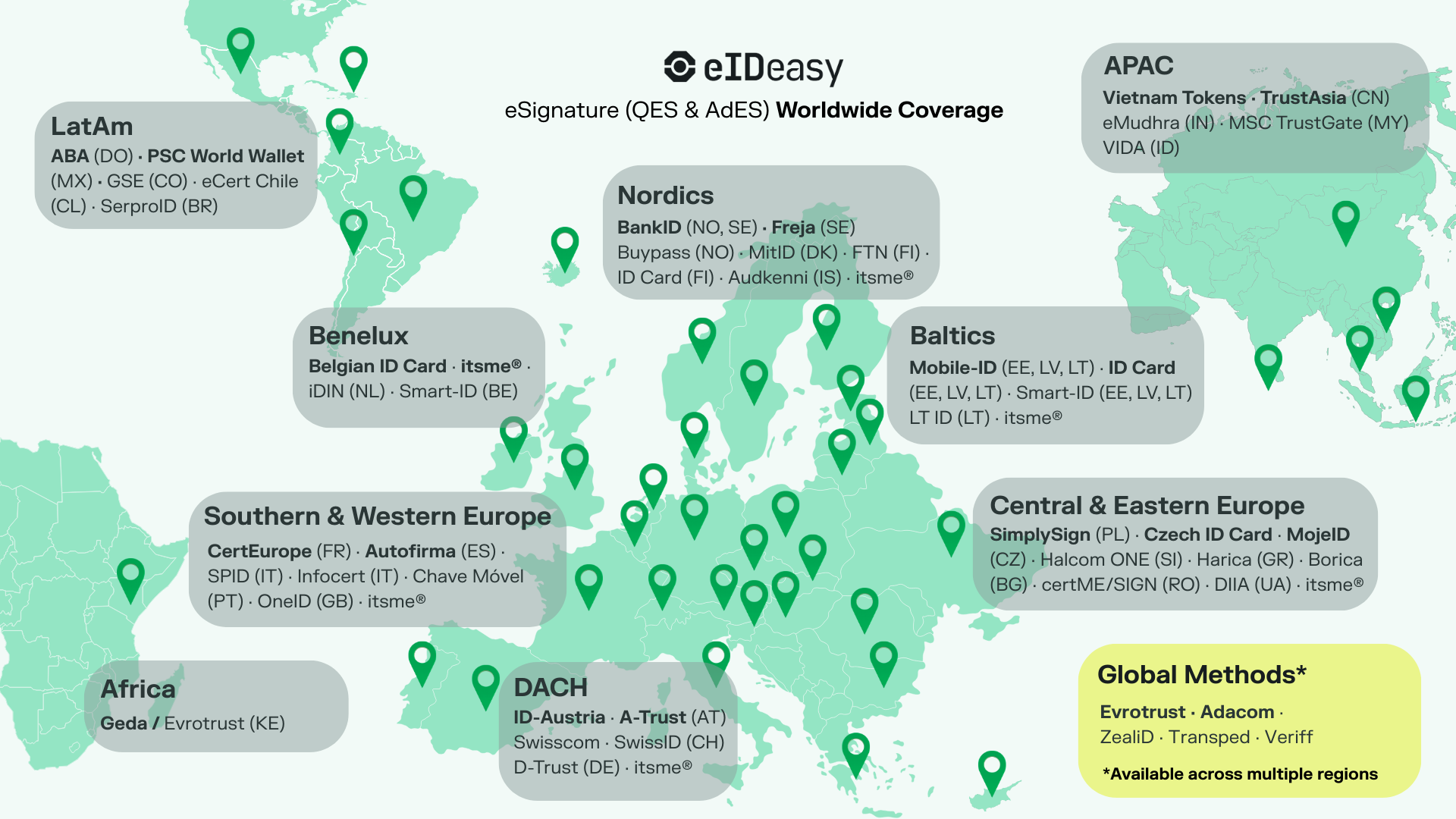
- QES, AdES, and trusted local methods for supported employment workflows
- Country- and document-level signing behind one consistent onboarding experience
- One API for employee and employer-side signing across Europe and beyond
A trusted signature layer for global employment platforms
Your platform already handles the hard parts: local employment contracts, payroll, benefits, onboarding, and the relationship between the worker and the legal employer. eID Easy handles the trust-provider layer behind the signature.
Your platform decides which signature method should be used for each country, document, and signer. The employee or employer representative completes the configured signing process, and the signed result returns to your system.
There is no need to show every available provider to every user. An employee signing a contract in one country should see the method relevant to that workflow, not a catalogue of every provider eID Easy supports.


THE OLD WAY
Global hiring, local signing infrastructure
The first country may be manageable. By the fifth, the signing layer can become a collection of local providers, separate contracts, and one-off technical decisions.
- A separate provider integration for each country, signature method, or document type
- Separate contracts, certificate onboarding, billing, support, and maintenance processes
- One-size-fits-all signing flows that do not account for different documents, signer roles, or legal requirements
Every new market becomes another project for legal, product, engineering, and operations—even though the core employment journey remains largely the same.

The EID Easy solution
One signing layer, configured by country and document
With eID Easy, the signing method can be configured around the workflow you are actually supporting: the country, document type, signer, required level of assurance, and locally available methods.
- Use QES for the highest level of assurance, or AdES for less restrictive workflows
- Preselect the appropriate method for employees and employer representatives instead of asking every signer to choose a provider
- Add countries, providers, and signing methods through the same API instead of rebuilding your HR product
eID Easy connects your platform to Qualified Trust Service Providers, Certificate Authorities, and identity methods while reducing the number of direct provider integrations your team needs to manage.
Designed for employment requirements that differ by country and document

eIDAS and Qualified Electronic Signatures
A QES receives an additional legal status: it has the equivalent legal effect of a handwritten signature. A QES based on a qualified certificate issued in one EU Member State must also be recognised as a QES in the other Member States.
This makes QES useful for employment documents requiring the highest level of identity assurance or where electronic form is being used to replace a statutory handwritten signature.

Electronic employment information in the EU
The EU Transparent and Predictable Working Conditions Directive requires employers to provide workers with information about the essential aspects of their employment relationship in writing.
That information may be provided electronically when it is accessible to the worker, can be stored and printed, and the employer retains proof of transmission or receipt.

ISO 27001-certified information security
Employment contracts contain sensitive identity, salary, tax, and address data. eID Easy is ISO 27001 certified, following an internationally recognised framework for managing information-security risks.
For privacy-sensitive workflows, hash-based signing lets the document stay in your environment while only its cryptographic hash is sent for signing.

How employment signing works with eID Easy
01.
Define the country, document, and signature level
Your legal or compliance team identifies the form required for the employment agreement, amendment, declaration, policy, or other workforce document.
Your platform then configures the appropriate supported method, such as QES, AdES, or another trusted local signature method.
The same country may use different methods for different documents.
02.
Prepare the document and identify the signers
Your platform generates the employment document and identifies everyone who needs to sign it.
Depending on the workflow, that may include:
1. The employee
2. An authorised representative of the local employing entity
3. An EOR or HR operations representative
4. Another internal approver
Your platform can show each signer only the method relevant to them rather than exposing the complete provider network.
03.
Complete the configured signing flow
Each party reviews the document and completes the identity, authentication, consent, or certificate steps required by the selected provider.
Some signers may already have a suitable national eID or qualified certificate. Others may need to complete identity verification and certificate issuance before signing.
For authorised employer representatives processing several documents, supported eID Easy methods can also sign multiple PDF, XAdES, or ASiC-E files in one signing session. Batch availability depends on the chosen provider and method.
04.
Return the signed result to your platform
Once signing is complete, the signed document or signature result returns to your system.
Your platform can store it with the employee record, distribute copies to the relevant parties, and continue with payroll, benefits, equipment, compliance checks, and the rest of the onboarding process.
At a technical level, the standard eID Easy API flow prepares the file, takes the signer through the configured provider process, and returns the signed result.
For privacy-sensitive employment documents, eID Easy also supports file-hash signing flows. These allow your platform to send only the document’s cryptographic hash for signing, while the document contents remain inside your own infrastructure.
Why Employer of Record and HR platforms choose eID Easy

Configure signing by country and document
Apply different methods according to the employment market, document type, signer role, and required level of assurance rather than forcing every workflow through the same provider.

Extend the signing experience you already have
Keep your existing document generation, onboarding journey, and user interface. Use eID Easy behind that experience to add QES, AdES, and locally trusted signing methods where they are needed.

80+ trusted providers and methods through one API
Access a worldwide network of Qualified Trust Service Providers, certificate authorities, and supported eSignature and eID methods without maintaining every integration separately.

Built for employee and employer-side signing
Support individual employees signing their own agreements alongside authorised employer representatives signing recurring or high-volume workforce documents. Where supported, batch signing allows several documents to be completed in one signing session.

Less provider overhead
Reduce the number of direct provider integrations, contracts, onboarding processes, support paths, and technical dependencies your team must manage.