For many digital identity flows, a successful login is only the first step.
If you are an identity verification provider, AML platform, fintech, onboarding platform, or regulated business, you often need more than confirmation that a user authenticated successfully. You need trusted identity data that can support verification, customer due diligence, risk checks, account creation, and smoother onboarding.
That is why we are further improving the data layer behind eID Easy’s eID authentication product.
Customers can now request richer identity attributes through selected eID methods, depending on the method, provider, available scope, and user consent.
What changed?
We expanded the identity data available through several supported eID authentication methods, including:
- itsme
- Chave Móvel Digital
- SPID
- OneID
- iDIN
- Czech BankID
- Swedish BankID
- Freja ID
- Smart-ID
- Norwegian BankID
- Polish eDO App
- MitID
- FTN
Need a method that’s not listed? Get in touch, we’re continuously expanding coverage and can discuss what’s possible.
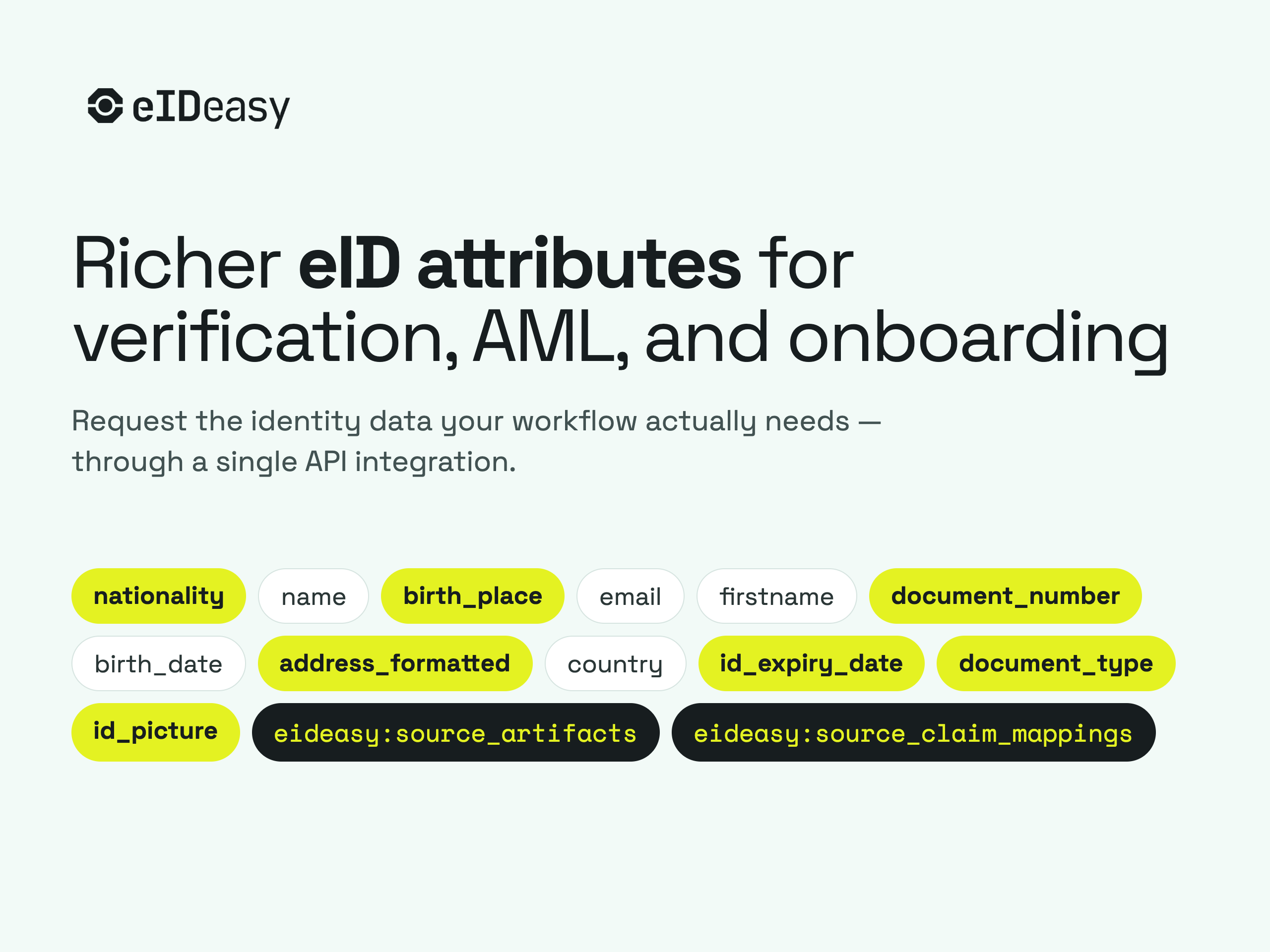
Through the eID Easy API, customers can request additional identity attributes where supported by the provider.
This can include data such as:
- full name
- first name and last name
- date of birth
- place of birth
- address
- formatted address
- nationality or citizenship
- country
- document number
- document type
- document expiry date
- phone number
- gender or official gender
- language
- ID picture, where available
The exact attributes vary by method. Not every provider returns the same data, and not every use case needs the same information. But the direction is clear: eID authentication becomes more useful when customers can receive trusted identity attributes in a consistent way through one integration.
Better context with source artifacts and claim mappings
We have also added support for two eID Easy-specific scopes:
eideasy:source_artifactseideasy:source_claim_mappings
These are especially useful for teams that need more transparency around the identity data they receive.
eideasy:source_artifacts gives customers more context about the source material behind the returned identity data.
eideasy:source_claim_mappings helps show how provider-specific claims are mapped into eID Easy’s normalized identity attributes.
In plain English: customers can better understand where the data came from and how it was translated into the standard eID Easy response.
That matters when you are working across different national eID methods, bank IDs, mobile IDs, and identity schemes, each with its own data structure and terminology.
Why this matters for IDV and AML platforms
For IDV providers and AML platforms, richer eID data can make a real difference.
A user logging in with a trusted eID method is valuable. But being able to receive structured identity attributes, document details, verified contact data, or source context can make that authentication much more useful inside a broader verification workflow.
It can help teams:
- reduce manual data entry
- pre-fill onboarding forms
- support customer due diligence checks
- compare user-provided data against trusted identity data
- improve AML and KYC workflows
- reduce friction in regulated onboarding
- build more consistent cross-border verification flows
This is especially relevant for companies operating across multiple countries. Instead of integrating directly with each local eID method and handling different data formats one by one, customers can access multiple trusted identity methods through the eID Easy API.
One API for cross-border eID authentication
Digital identity is still fragmented across Europe and beyond.
Different countries use different eID methods. Providers return different attributes. Some flows are focused on login, others on verified identity data, onboarding, or compliance.
eID Easy helps businesses manage that complexity through one integration.
By expanding available eID attributes and adding better source context, we are making our eID authentication product stronger for real-world use cases, especially where identity data needs to support verification, AML, onboarding, and compliance workflows.
The goal is simple: make trusted identity data easier to access, easier to understand, and easier to use across borders.