The EU’s new anti-money laundering framework is changing how regulated businesses think about customer identification.
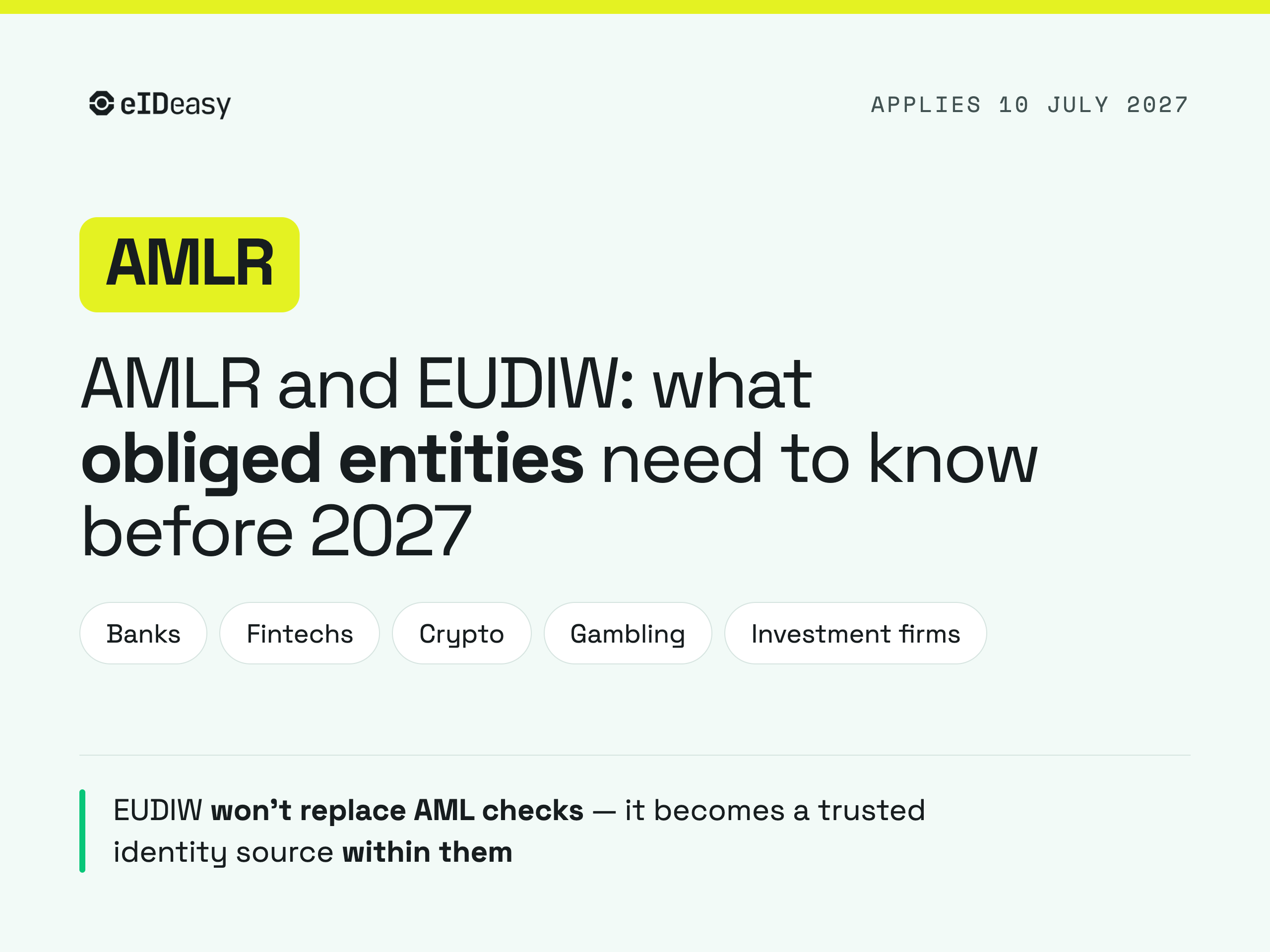
The Anti-Money Laundering Regulation (AMLR), officially Regulation (EU) 2024/1624 on the prevention of the use of the financial system for the purposes of money laundering or terrorist financing, introduces a single AML rulebook across the EU. It applies from 10 July 2027, with some specific exceptions applying from 2029.
For banks, fintechs, crypto platforms, payment institutions, insurers, investment firms, and other obliged entities, this matters for several reasons.
One of them is digital identity.
Under Article 22, obliged entities may use electronic identification means that meet the requirements of Regulation (EU) No 910/2014, with assurance levels substantial or high, and relevant qualified trust services, to verify customer identity.
That makes the European Digital Identity Wallet highly relevant for future AML and KYC flows.
But let’s be clear from the start:
EUDI Wallet will not replace AML checks.
It will not become an AML tool by itself.
It can become a trusted digital identity source inside AML/KYC processes.
In this post
We’ll cover:
- what AMLR changes
- who is affected
- how AMLR differs from the previous AML Directives
- where EUDI Wallet fits into customer identification
- what obliged entities should prepare for
- how eID Easy can help teams use wallet-based identity data in onboarding and verification flows
Quick answers
What is AMLR?
Anti-Money Laundering Regulation (AMLR) is the EU’s new directly applicable anti-money laundering regulation. Unlike the previous AML Directives, it does not need to be transposed into national law in the same way. The goal is to create a more harmonised AML/CFT rulebook across the EU.
When does AMLR apply?
AMLR applies from 10 July 2027, with some specific exceptions applying from 10 July 2029.
Who is affected by AMLR?
AMLR applies to “obliged entities”. This includes financial institutions, banks, payment institutions, e-money institutions, crypto-asset service providers, insurance and investment firms, as well as lawyers, notaries, tax advisors, real estate agents, and some newer sectors such as crowdfunding platforms, professional football clubs, and consumer credit intermediaries.
Does AMLR mention digital identity?
Yes. Article 22 allows obliged entities to use eIDAS-compliant electronic identification means with assurance levels substantial or high, as well as relevant qualified trust services, for identity verification.
Does this mean EUDI Wallet replaces AML/KYC?
No. EUDI Wallet can support customer identification and verification, but obliged entities still need AML processes, risk assessment, screening, monitoring, governance, and controls.
AMLR is coming
The AMLR entered into force in July 2024 and becomes applicable in July 2027, with some later exceptions. By then, obliged entities will need to adapt governance frameworks, internal controls, data quality standards, onboarding procedures, and customer identification processes to the new EU-level requirements.
That timeline matters because AMLR and EUDI Wallet timelines are now moving toward the same practical question:
How will regulated businesses identify and verify customers in a more digital, cross-border, EU-wide way?
From directives to a single rulebook
The biggest structural change is the move from AML Directives to an AML Regulation.
The previous AML Directives followed a more decentralised model. Each Member State had to transpose the rules into national law, which left room for different interpretations, thresholds, and supervisory practices.
For companies operating across borders, that created complexity.
A business could face different KYC and KYB expectations depending on the country, the supervisor, and the national implementation.
AMLR changes the model.
It introduces a uniform set of AML/CFT rules across the EU — often described as a single rulebook. The goal is a more harmonised EU-wide AML/CFT operating model.
This does not remove every national difference. Supervision, implementation, and sector-specific guidance will still matter.
But it does move the EU AML framework toward more consistency.
Who will be affected?
AMLR applies to “obliged entities”.
That includes a broad set of regulated businesses and professionals, such as:
- banks
- payment institutions
- e-money institutions
- crypto-asset service providers
- insurance firms
- investment firms
- lawyers
- notaries
- tax advisors
- real estate agents
- crowdfunding platforms
- professional football clubs
- consumer credit intermediaries
The practical impact will vary by sector, but the direction is clear: more organisations will need strong, consistent, auditable customer identification and verification processes.
AMLA adds a new supervisory layer
AMLR is not the only change.
The EU is also establishing AMLA, the Authority for Anti-Money Laundering and Countering the Financing of Terrorism.
AMLA will not replace national supervisors. Instead, it will work with them through an integrated supervisory system and gradually take on direct oversight of selected high-risk institutions from 2028. Selection will depend on factors such as risk profile, cross-border activity, and size.
For cross-border businesses, this reinforces the same direction: more EU-level consistency, more coordination, and more pressure to have clean, explainable AML controls.
Where EUDI Wallet fits into AMLR
Article 22 of AMLR is the key part for digital identity.
It says obliged entities must obtain the information, documents, and data needed to verify the identity of customers and persons acting on their behalf. For that verification, they may use electronic identification means that meet eIDAS requirements at assurance levels substantial or high, and relevant qualified trust services.
That is where EUDI Wallet becomes relevant.
The EUDI Wallet is being developed under the eIDAS framework. For AML/KYC teams, the important point is not that wallets replace due diligence. They do not.
The point is that wallets can provide a trusted digital identity channel that obliged entities may use as part of customer identification and verification.
In practice, that could help with:
- collecting verified identity attributes
- reducing repeated document upload
- improving data quality at onboarding
- supporting cross-border customer identification
- requesting only the attributes needed for the use case
- building more structured identity evidence into the onboarding flow
EUDI Wallet is not an AML tool
This is important.
EUDI Wallet does not decide whether a customer is low risk or high risk.
It does not screen sanctions lists.
It does not perform transaction monitoring.
It does not replace beneficial ownership checks, risk assessment, suspicious activity reporting, or ongoing due diligence.
Instead, EUDI Wallet can provide trusted identity infrastructure that obliged entities can use to satisfy parts of their customer identification and verification obligations. The compliance officer draft makes this distinction clearly: EUDI Wallet is expected to play an important role in the future AML/KYC ecosystem, but it will not replace AML processes or become an AML tool itself.
That distinction should guide how businesses prepare.
The question is not:
“Will EUDI Wallet do AML for us?”
The better question is:
“Where can wallet-based identity data improve our AML/KYC onboarding flow?”
What this means for obliged entities
For obliged entities, the practical impact sits at the intersection of compliance, product, data, and identity infrastructure.
Teams should start mapping:
- which customer identification steps could use wallet-based identity data
- which attributes they actually need
- whether they need full identity data or only specific claims
- how wallet-based data will be stored, logged, and audited
- how wallet flows will sit alongside existing KYC providers
- how fallback methods will work when a wallet is not available
- how wallet-based identity will fit into customer due diligence and ongoing monitoring processes
This also matters for customer experience.
A wallet flow could be simpler for users than uploading documents manually, but only if the relying party asks for the right data, explains the request clearly, and handles fallback paths properly.
Where eID Easy fits
eID Easy already aggregates national eIDs, Bank IDs, and digital signature services through one integration.
As EUDI Wallets become available, eID Easy is building the eID Easy Wallet Hub to help organisations interact with digital identity wallets from the 27 EU Member States and beyond, including private sector wallets and business wallets.
For AML/KYC use cases, the Wallet Hub is designed to help obliged entities access wallet-based identity data without having to manage every wallet, standard, data format, registration path, and technical integration alone.
The Wallet Hub is built to:
- provide a single API integration for Wallet Relying Parties and Credential Issuers
- manage compliance with evolving technical standards and data formats across integrated wallets
- harmonise the processing of digital credentials across wallets
- support relying party and credential issuer access workflows
- provide credential templates to support access requests to national authorities
- integrate with QTSPs to enable wallet-based remote signature flows
The point is not to replace AML responsibility.
The obliged entity remains responsible for its compliance framework, risk assessment, customer due diligence, and use of the data.
The point is to make wallet-based identity access manageable.
Final takeaway
AMLR makes customer identification more harmonised across the EU.
EUDI Wallet gives obliged entities a new trusted digital identity channel to watch closely.
Together, they point toward a more structured, digital, and cross-border approach to customer onboarding and identity verification.
But EUDI Wallet will not replace AML/KYC.
It will sit inside it.
For obliged entities, the next step is to understand where wallet-based identity data fits into onboarding, what attributes are needed, how wallet flows connect to existing KYC processes, and whether direct wallet integration or a Wallet Hub model makes more sense.
Preparing for AMLR and EUDI Wallet?
Talk to eID Easy about how Wallet Hub can help you access wallet-based identity data through one integration layer.