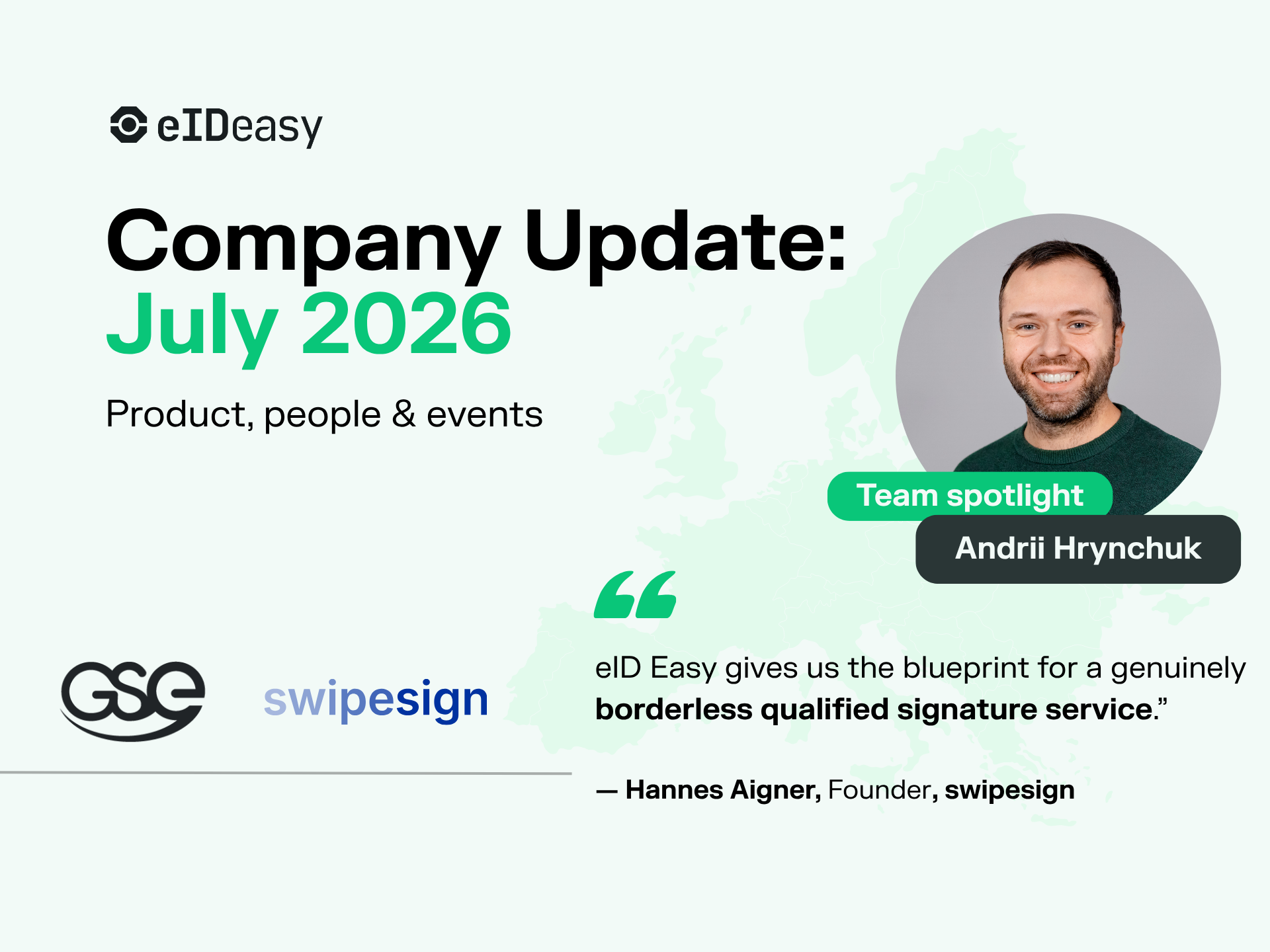
Here’s a quick look at what we built in the past month, what’s moving forward on the roadmap, and where the team has been active across the ecosystem.
Product progress, partnerships, and the people behind it: all in one place.
1. Product Update: July 2026
This month, we improved the data available through our eID authentication product and continued working on EUDIW.
Richer identity attributes
Customers using selected eID methods, including itsme, Chave Móvel Digital, SPID, OneID, iDIN, Czech BankID, Swedish BankID, Freja ID, Smart-ID, Norwegian BankID, Polish eDO App, MitID, and FTN, can now request richer identity attributes through the same eID Easy API.
We also added support for eideasy:source_artifacts and eideasy:source_claim_mappings, giving customers more context on where identity data comes from and how provider-specific claims map into eID Easy attributes.
This is especially useful for IDV, AML, KYC, onboarding, and customer due diligence workflows, where teams need trusted user data, not just a successful login.
→ Read more about richer eID data for verification workflows
.png)
2. Coming Up Next: What Product Team Is Working On
The product team is still focused on three national eID methods and one wallet sandbox: SPID in Italy, ID Austria, mObywatel in Poland, and the Swiss Swiyu wallet sandbox.
It’s a good reminder of why aggregation matters. Adding national eID schemes is not always a simple technical switch. There are registrations, approvals, government processes, local rules, and plenty of moving parts that do not always depend on us.
That is exactly the kind of complexity we work through, so customers do not have to go direct to every scheme country by country.
Near-term priorities:
SPID, Italy
We’re being onboarded as an official SPID aggregator, which will allow us to offer SPID as an authentication method through the eID Easy API. This is a major step for customers who need to verify Italian users online, especially for onboarding, account access, and regulated user flows.
ID Austria
We’re also being onboarded as an official ID Austria Service Provider, giving customers a technical integration layer to access ID Austria authentication through our API. For businesses serving Austrian users, this adds another trusted national eID method through the same eID Easy integration.
mObywatel, Poland
mObywatel is also on the near-term roadmap, helping us expand eID coverage in Poland. Once available, it will support businesses that need to authenticate Polish users as part of online services, onboarding, or other digital journeys.
Swiss Wallet, Swiyu
On the wallet side, we’re preparing access to the Swiss Swiyu wallet sandbox. This will allow customers to test wallet-based journeys, including identity credential verification and trusted attribute sharing, before production access becomes available.
Together, these updates support the same goal: broader trusted identity coverage through one API, with early access to the wallet-based flows that are coming next.
2026 Roadmap Highlights
- Digital Identity Wallet (DIW) integrations, with business-ready flows and APIs
- Expanded eID coverage across Europe (Poland, Italy, Spain, Germany, and more)
- Uptime and performance improvements across high-demand methods
- Enhanced analytics and reporting for better operational and client insights
3. Customer Story of the Month
From National eIDs to Borderless QES: How swipesign Builds a Faster Signing Experience with eID Easy
swipesign ran into the same problem most eSignature and document workflow platforms hit when they start scaling across Europe:
Every country has its own trusted eID.
Every method needs work.
And video ID should not be the default fallback for people who already have a recognised national eID.
So they turned to eID Easy.
With one integration, swipesign connects to nationally notified EU eID and signature schemes, giving signers a faster, more familiar route to QES across covered markets.
They also use our eSealing to add verifiable proof of integrity and origin to completed documents.
Why it matters:
→ Less video-ID fallback
→ Under 2-minute eID authentication
→ Better support for their “7 minutes to first signature” promise
→ One integration reused across covered countries
This is exactly why aggregation matters.
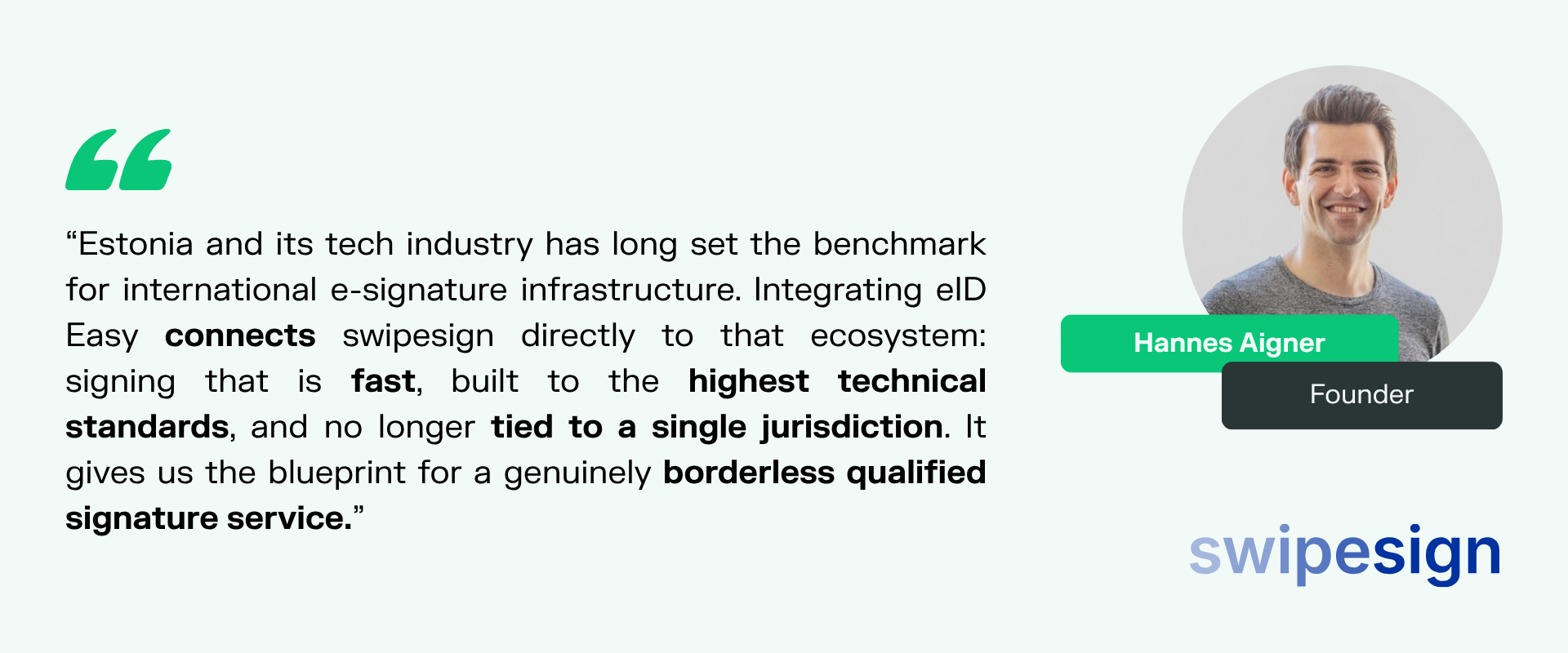
— Hannes Aigner, Founder, swipesign
4. Provider Story of the Month
Colombia’s longest-standing accredited certificate authorities
This month we highlight Gestión de Seguridad Electrónica (GSE) as we're expanding our partnership. GSE is one of Colombia’s longest-standing accredited certificate authorities, GSE has been accredited by ONAC since 2016 and has issued more than 560,000 digital signature certificates, supporting major national digital transformation initiatives such as Colombia’s DIAN e-invoicing rollout.
Through its international subsidiary, Letmi, GSE has expanded its trust infrastructure across the region with accredited trust service providers in Panama and Ecuador, enabling legally compliant digital signature services throughout these three jurisdictions.
Over the coming weeks, we'll integrate these new services into our platform, allowing customers to obtain and use GSE/Letmi digital certificates for advanced electronic signatures, legal representative certificates, individual certificates, and corporate seals, all compliant with the applicable legal frameworks in each country.
This partnership enables international organizations operating across Colombia, Panama, and Ecuador to work through a single integration while ensuring compliance with each country’s electronic signature legislation, including Colombia’s Law 527 of 1999, Panama’s Law No. 51 of 22 July 2008, and Ecuador’s Electronic Commerce, Electronic Signatures and Data Messages Law (Law 67 of 2002).
For companies expanding across Latin America, this provides a simpler, trusted, and scalable way to execute legally binding digital agreements across multiple jurisdictions through a single technology integration.
"Extending our certificate infrastructure into Panama and Ecuador through Letmi means one thing for international companies operating in the region: you no longer need three separate vendors and three separate compliance headaches to get a legally binding signature in Bogotá, Panama City, and Quito. Through eID Easy, it's one integration, three jurisdictions covered."
- Leonardo Maldonado, Partnerships Director, GSE
5. Under the Hood: Team Spotlight
Andrii Hrynchuk, Lead Software Engineer
This month, we’re introducing Andrii, our Lead Software Engineer
He is focused on architecting and building solutions for the uncommon, messy, and challenging problems that come with digital identity, signatures, and wallet infrastructure.
He also leads and mentors the engineering team, helping turn complex technical questions into systems that can actually work reliably for customers.
Before eID Easy?
Before joining eID Easy, Andrii spent five years at Ampler Bikes, where he started as a solo developer and eventually built a team of 10 people.
What began as an e-shop grew into a much larger technical ecosystem, including a centralized core system for orders, production planning, stock management, customer warranties, and more. He also built scalable infrastructure that helped the company serve hundreds of thousands of monthly online users.
After that, he worked at x7trade, a platform helping airport ground handlers manage customs clearance across eight EU countries.
Why eID Easy?
Digital identity had already been on Andrii’s radar for a while.
After moving to Estonia, he became interested in how ID-card and Smart-ID login worked, and even wanted to integrate them into a website “just for fun.”
Later, while working at x7trade, he was looking for an automated way to sign ASiC containers for the Slovakian customs office, and found the eID Easy documentation.
That was the start of his interest in the company and the world of APIs, identity, and signatures we work with every day.

What makes engineering at eID Easy interesting?
For Andrii, one of the most interesting challenges has been wallet integrations.
He was one of the first people at eID Easy to dive into wallet-related topics, which means working in a space where standards are still evolving, documentation is not always perfect, and every country seems to be building things slightly differently.
As he puts it:
"Somehow this whole orchestra still has to play together."
That is exactly the kind of engineering challenge eID Easy is working on: making it possible for businesses across Europe to reliably communicate with user wallets, even while the ecosystem is still taking shape.
What does good engineering mean to him?
Andrii keeps it simple:
“Good code reads like poetry. Documentation is another level of masterpiece to that.”
Which feels very fair. Especially in a field where the difference between “technically works” and “someone can actually integrate this” matters a lot.
What does he enjoy about the team?
For Andrii, the best part of working with the team is being able to challenge each other’s ideas.
Not for the sake of arguing, but to find better solutions. The kind that are more stable, more scalable, and more useful once they leave the whiteboard and meet real customer use cases.
Outside of work?
Outside work, Andrii is a father of three, which keeps him active and constantly learning.
He also plays padel, reads books, and somehow found time to go deep into the world of tea. Actually, he and his wife opened an online shop selling selected premium functional tea blends and matcha.
So yes, wallet infrastructure by day, matcha by night.

What does “making trust simple” mean to him?
To Andrii, trust needs to be backed by something real: reliability, experience, and proof.
For eID Easy, that means years of uninterrupted working experience, customers who already trust us, and systems that make trust verifiable.
And that is a pretty good summary of what engineering at eID Easy is all about.
7. Resources & Useful Links: Digital Identity Exchange Community
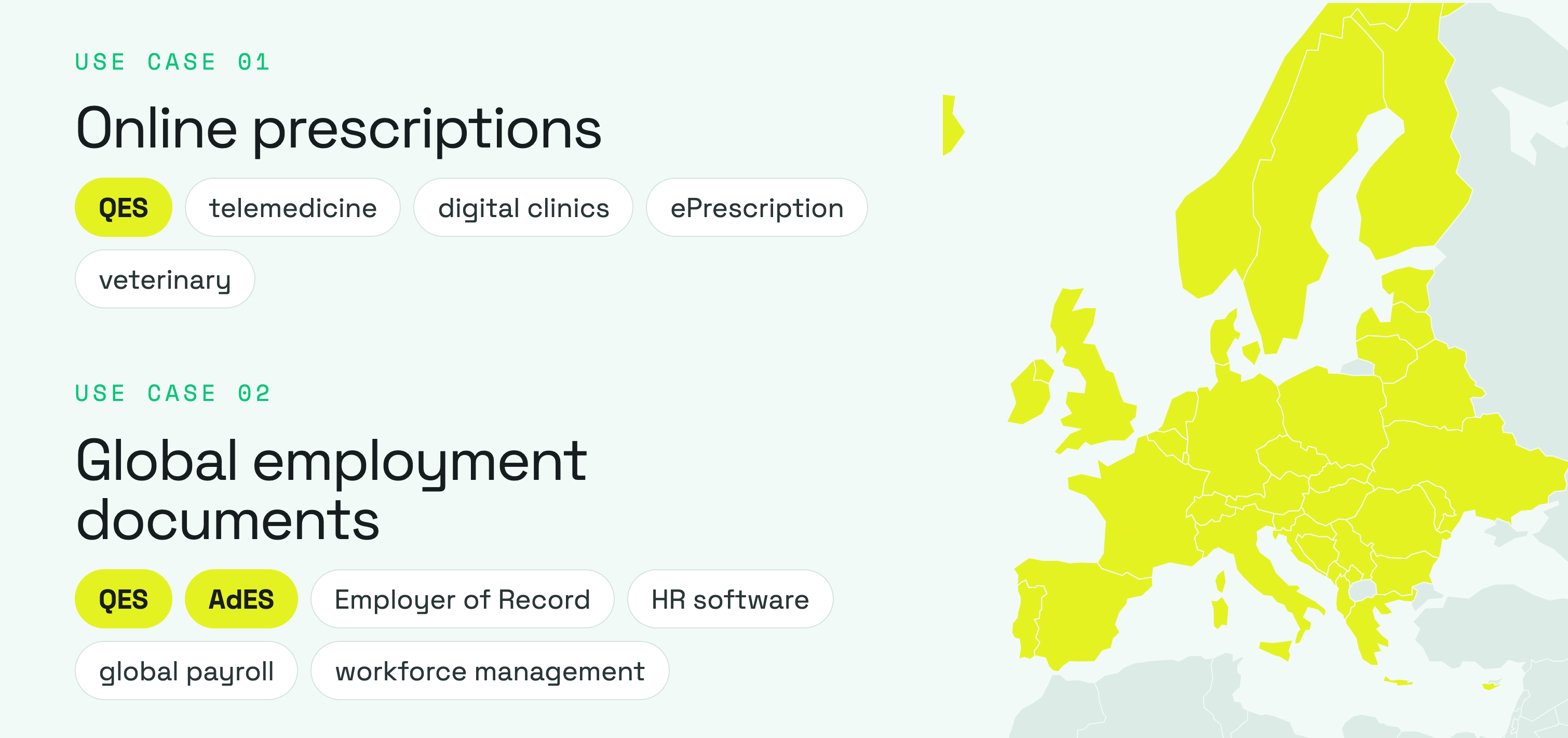
Two QES use cases we keep seeing
Lately, our team has seen more companies asking the same practical question: how do we add the right electronic signature method without rebuilding the workflow country by country?
Two areas come up a lot: online prescriptions and global employment documents.
For telemedicine, digital clinics, ePrescription platforms, and veterinary systems, we cover how QES can support trusted prescription signing workflows.
For Employer of Record platforms, HR software, global payroll, and workforce-management tools, we cover how QES, AdES, and local signing methods can support employment contracts and onboarding documents across Europe.
→ Global employment / HR use case
Explore More
→ Sign up for product updates – One email per month. No spam.
→ Follow us on LinkedIn – Product news, team stories, and events.
Thanks for reading and for being part of the growing eID Easy community. If something here caught your eye, a product update, an event, a use case, we’d love to talk more.
Catch you next month with more updates from across the company.