EU Digital Identity Wallet (EUDIW): A Comprehensive FAQ for Businesses
The EU Digital Identity Wallet (EUDIW) is one of the most significant changes to digital identity in Europe in recent years. While the regulatory framework is complex, the practical questions businesses ask are often very simple:
What is it? Who needs to support it? When does it matter? And how do we prepare without rebuilding everything?
This FAQ answers all these questions:
1. What is the EU Digital Identity Wallet?
The EU Digital Identity Wallet (often shortened to EUDIW or EUDI Wallet) is a digital wallet application, typically on a user’s phone, that stores verified digital credentials issued by trusted authorities.
The wallet allows users to share only the information required for a specific interaction, under their control.
2. Is the wallet a physical document or a replacement for passports?
No.
The EUDI Wallet:
- is not a physical document,
- does not replace passports or ID cards,
- and does not require users to stop using existing identity methods.
It is an additional, standardised digital way to prove identity and attributes, designed to work across EU borders.
3. What can an EU Digital Identity Wallet contain?
An EU Digital Identity Wallet is designed to store high‑assurance digital credentials and electronic attestations of attributes issued by trusted public bodies or authorised private entities. These can represent official documents or individual attributes, including:
Identity and personal information
- Electronic proof of identity linked to national registers (for example, ID card or passport details).
- Date of birth or age confirmation (including “over 18” style proofs).
- National identification number, where applicable under national law.
- Proof of residence or address.
- Citizenship or residency status.
Work, education, and legal status
- University degrees and diplomas, stored as verifiable credentials.
- Professional qualifications and licences issued by professional bodies.
- Employment‑related credentials (for example, role, employer, or affiliation where supported).
- Right‑to‑work or right‑to‑reside confirmations, especially for cross‑border mobility.
- Proof of professional status or legal mandate (for example, acting on behalf of a company).
Access, mobility, and eligibility
- Digital driving licences and vehicle‑related credentials, already piloted in several EUDI projects.
- Bank‑verified identity attributes and proof of account ownership, issued by financial institutions.
- Eligibility confirmations (such as access rights, benefits, entitlements, or subscription rights).
A core design principle is data minimisation: relying parties should receive only the specific attributes required for a transaction, not entire documents, and users must retain control and consent over what is shared.
4. Is the EU Digital Identity Wallet mandatory for users?
No, the wallet is not mandatory for individuals.
- Individuals are not required by EU law to use a European Digital Identity Wallet.
- Physical documents (such as passports, ID cards, and paper certificates) and existing digital identification methods (like national eIDs or bank IDs) remain valid.
- The wallet is designed as an additional, EU‑wide option for identification, authentication, and attribute sharing, not an automatic replacement.
The main new legal obligations apply to certain relying parties and sectors, not to end users.
5. When does the EU Digital Identity Wallet matter?
The key milestones are already set:
By the end of 2026
Every EU country has to make at least one official EU Digital Identity Wallet available to its citizens and residents. That’s when wallets start to show up in real‑world apps, not just in pilots.
By the end of 2027
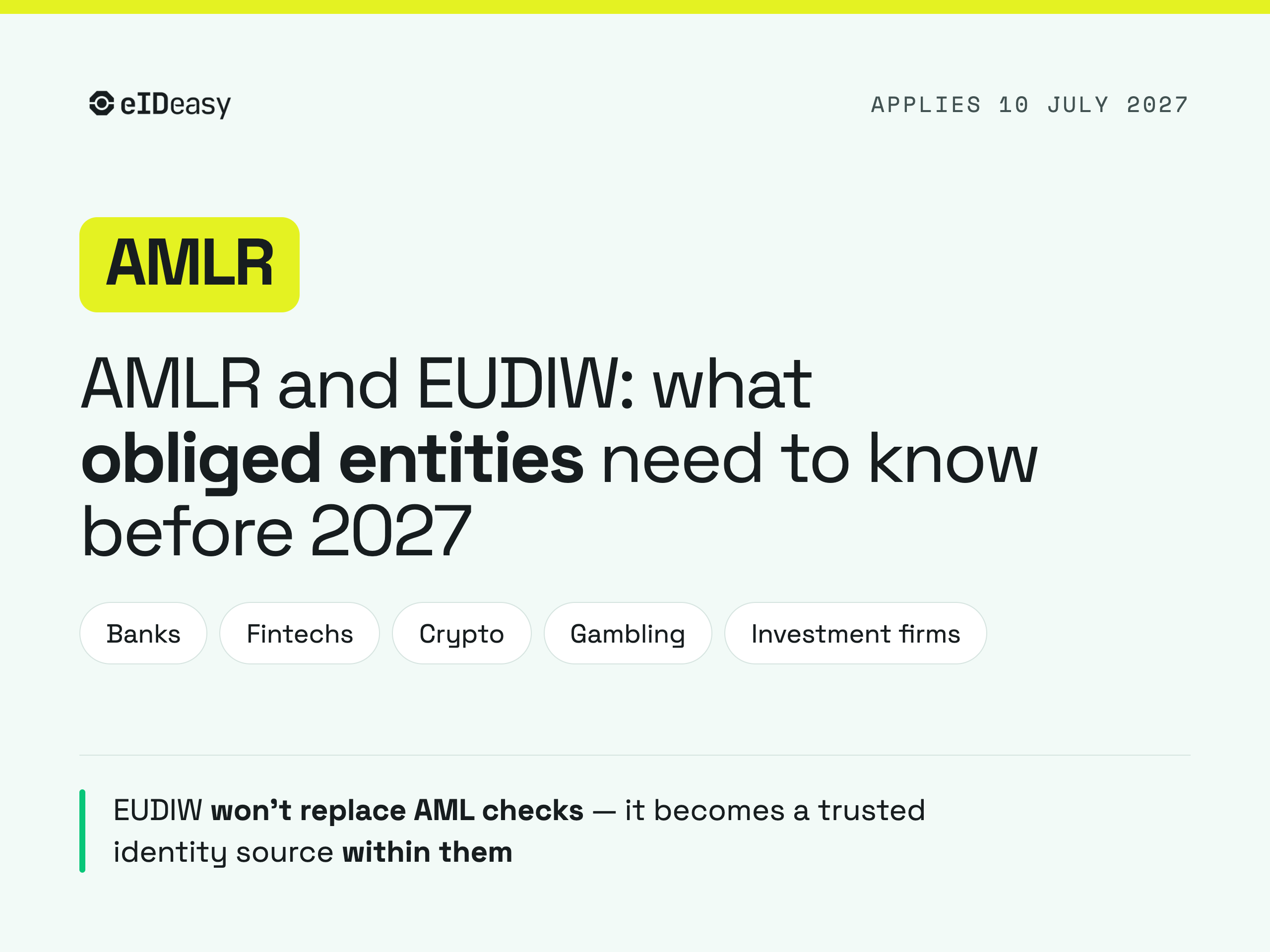
Certain regulated organisations will have to accept the wallet for identification and strong authentication in journeys where they already have a legal obligation to identify users or apply strong login, and where the user chooses to use their wallet instead of another method.
From a business point of view, the wallet becomes relevant as soon as:
- A national wallet is live in a market you operate in, and
- You’re in a sector covered by the new rules (for example, financial services, payments, telecoms, utilities, public services) and you’re not a micro or small enterprise that only does low‑risk identification.
6. Which organisations must accept the EU Digital Identity Wallet by 2027?
The acceptance obligation is tied to existing legal or contractual requirements for strong electronic identification and authentication. In particular:
- Public sector bodies that already require electronic identification to access online services must accept wallets that comply with the regulation.
- Private relying parties, except micro‑ and small enterprises, that are required by EU or national law (or by contract) to use strong user authentication for online identification in specific sectors must also accept wallets within 36 months of the implementing acts.
Examples of affected private‑sector categories often cited include:
- Banking and financial services (including KYC/AML onboarding).
- Payments and fintech providers.
- Telecommunications operators (for example, SIM registration).
- Energy and utility providers.
- Providers of services in transport, social security, health, drinking water, postal services, and digital infrastructure.
- Education providers and certain professional or regulated digital services.
This does not mean wallets become the only method of identification. It means that for in‑scope services, the wallet must be accepted as one of the valid options, on the same footing as other accepted identification methods, when users choose to use it.
7. What does it mean to “accept” the EU Digital Identity Wallet?
Accepting the wallet means behaving as a registered relying party that can technically and legally handle wallet‑based credentials. In practice, this means:
- Allowing users to identify or authenticate themselves using credentials or attributes presented from their EUDI Wallet.
- Trusting those credentials in line with eIDAS 2.0 rules, applicable assurance levels, and national guidance.
- Processing the received data securely and compliantly under GDPR, sector regulations, and internal control frameworks.
It does not mean:
- Removing document‑based onboarding or in‑person identification options.
- Discontinuing existing national eIDs, bank IDs, or other compliant identity schemes.
- Outsourcing all compliance decisions to the wallet; relying parties remain responsible for their own AML/KYC and risk‑based controls.
7. What is a “relying party” in the EUDIW context?
A relying party is any organisation that relies on identity data or verified attributes issued by another entity to identify or authenticate a user, or to decide on access, rights, or eligibility.
If your organisation:
- Verifies identity for onboarding or account management,
- Authenticates users for secure access,
- Or checks regulated attributes (such as age, residence, professional status, or mandate),
and you accept credentials from the EU Digital Identity Wallet, you are acting as a relying party, even if identity is not your primary business.
Many organisations will become relying parties for the wallet ecosystem simply because existing laws (for example, PSD2, AMLD, sector rules) will require them to accept the wallet in the same way as other identification methods once the deadlines apply.
8. Which industries are most affected?
EUDIW affects services where identity is essential for access, compliance, or trust. That includes a wide range of regulated and semi-regulated sectors.
Core regulated sectors
- Banking and financial services.
- Payments and fintech.
- Telecommunications.
- Energy and utilities.
- Public and social security services.
- Healthcare (where electronic identification is used and permitted under national law).
Often overlooked but important use cases
- Education platforms and universities verifying degrees, diplomas, or student status.
- Professional bodies and regulators verifying licences, membership, or mandates.
- Mobility and transport services with identity‑linked access rights (for example, personalised passes).
- Postal and logistics services that handle identity‑sensitive deliveries or age‑restricted items.
- Digital infrastructure, cloud, and access‑management providers controlling access to regulated platforms or critical systems.
- Employment and cross‑border right‑to‑work or right‑to‑reside verification, especially for remote hiring and mobility.
These use cases typically depend on verified attributes rather than full documents, which aligns closely with the wallet’s design.
9. Are very large online platforms affected?
Yes.
Very large online platforms (VLOPs) and other major digital intermediaries are widely expected to play a role in wallet adoption, especially where strong authentication and traceable identity are important. Marketplaces, app stores, search engines, social networks, and major content platforms are being encouraged or required in some contexts to support EUDI Wallet‑based identification where legally required and when users request it.
For these platforms, wallets intersect strongly with:
- User authentication and account security.
- Trust and safety functions (for example, fraud prevention, abuse prevention).
- Regulatory accountability at scale under frameworks such as the Digital Services Act and other sector rules.
10. How does Strong Customer Authentication (SCA) relate?
Strong Customer Authentication (SCA) has been in effect under PSD2 for electronic payments in the EU and EEA since around 2021, following transitional periods. Organisations that must apply SCA today:
- Already operate in an environment where strong user authentication and reliable identity checks are mandatory.
- Are among the clearest candidates for wallet‑acceptance obligations under eIDAS 2.0, especially if they are not micro‑ or small enterprises.
The EUDI Wallet does not replace SCA; instead, the wallet becomes another high‑assurance way to perform identity‑related checks that can support or fulfil SCA requirements where appropriate.
11. Does the EU Digital Identity Wallet replace KYC or AML?
No.
The wallet is a tool for delivering verified identity data and attributes, but it does not change who is responsible for compliance:
- It does not replace KYC or AML obligations; regulated firms must still perform risk‑based due diligence and monitoring.
- It does not automatically approve clients or transactions; policy decisions remain with the relying party.
- It does not remove regulatory liability; supervisors will still evaluate how firms use wallet data within their compliance frameworks.
What it does provide is a high‑assurance, standardised way to obtain identity and attribute data, which can simplify and strengthen existing KYC/AML and onboarding processes.
12. What identity methods exist today, before wallets?
Before and alongside wallet deployment, European digital identity already relies on:
- National government‑issued eIDs (for example, national ID card schemes, mobile IDs).
- Bank‑based identity schemes (such as BankID‑style systems).
- Other certified eID and authentication solutions used for onboarding, authentication, and electronic signing.
These methods are deeply embedded in many markets and will continue to operate; the wallet framework is designed to coexist and interoperate with them rather than suddenly replace them.
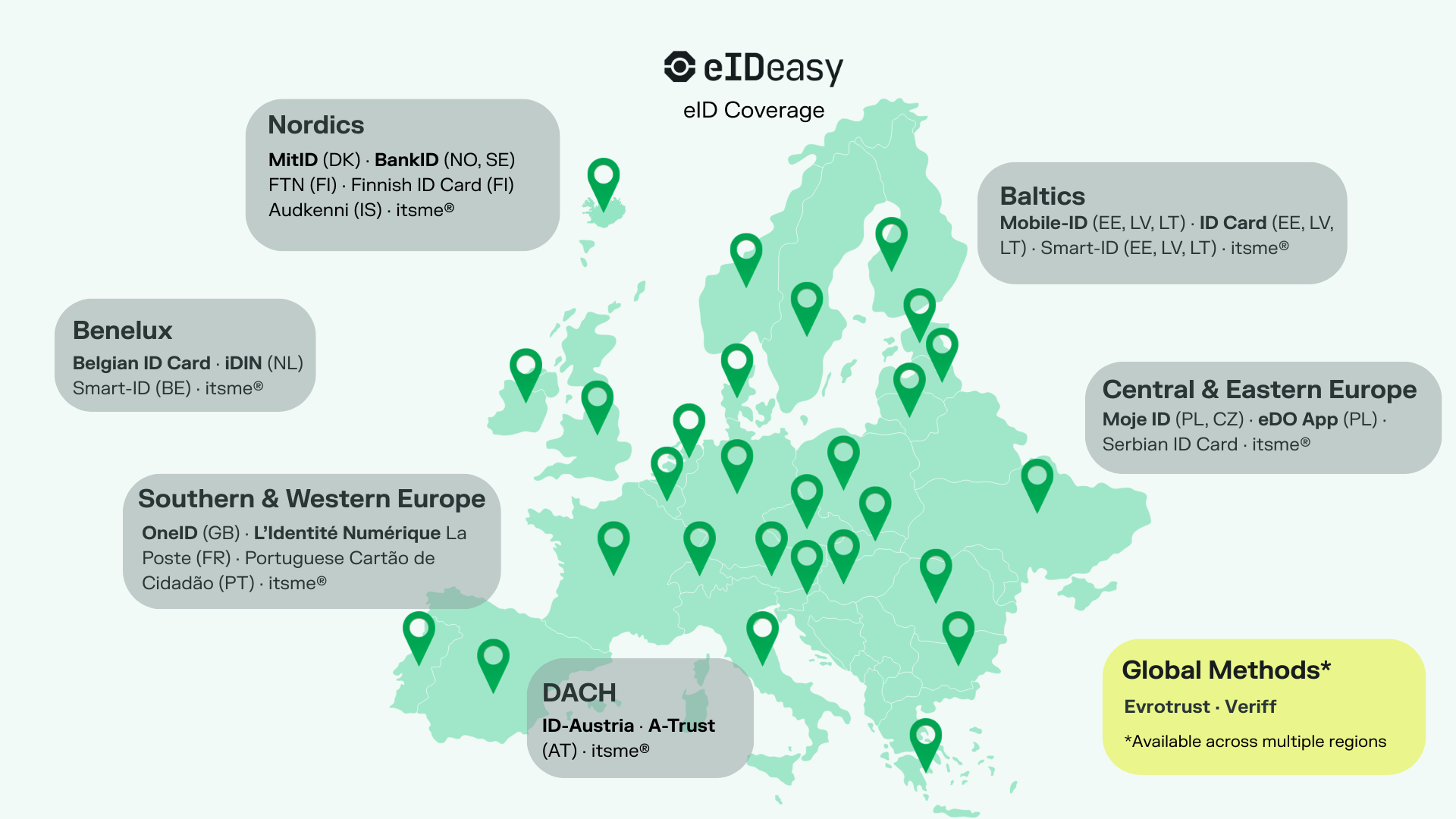
eID Easy already provides access to more than 20 of these national and bank‑based eID methods through a single integration, so organisations can rely on today’s proven schemes while adding EU Digital Identity Wallet support as it becomes available.
13. How does eID Easy fit into the EU Digital Identity Wallet ecosystem?
eID Easy acts as an identity aggregation layer for organisations that want to integrate multiple European eID methods and, over time, EU Digital Identity Wallets through a single API integration.
Through one integration, eID Easy already connects organisations to:
- National eIDs provided by governments and trust‑service providers.
- Bank‑based identity schemes used for high‑assurance login and signing.
- Other trusted electronic identity providers across Europe.
As the EU Digital Identity Wallets are launched country by country, eID Easy’s wallet support is added alongside existing eID methods, using the same aggregation layer and APIs. This lets organisations adopt EUDIW without separately integrating each national wallet implementation.
14. What does this mean in practice for businesses using eID Easy?
With eID Easy, organisations can:
- Use trusted national and bank‑based eIDs today for onboarding, authentication, and signing in multiple European markets via a single API.
- Add EU Digital Identity Wallet support progressively as wallets become available in their priority countries, without re‑architecting their identity stack.
- Avoid fragmented, country‑by‑country integrations with different wallet providers or intermediaries.
- Maintain one main technical and commercial relationship with an aggregation provider that evolves as regulations and wallet implementations mature.
- Treat wallet‑based identity as an extension of their existing identity flows rather than a big‑bang replacement.
15. Should organisations wait until 2027 to act?
No. Waiting increases the risk of rushed and inconsistent implementations. For organisations with complex journeys, multiple markets, long procurement cycles, or outsourced identity operations, early preparation is critical.
Delaying until obligations are imminent can lead to:
- Rushed integrations and technical shortcuts.
- Fragmented solutions across markets or business units.
- Inconsistent user experiences between identification methods.
- Last‑minute compliance pressure and higher project risk.
Engaging early with intermediaries such as eID Easy allows gradual, controlled adoption and testing of wallet flows alongside existing eIDs.
Final takeaway
The EU Digital Identity Wallet does not create a single, central EU wallet; it defines a common framework for interoperable, nationally issued wallets that must be recognised and, for many services, accepted across the European Union.
eID Easy offers a practical route: build on the national and bank‑ID methods that already work today, then extend your integration to support EU Digital Identity Wallets as they roll out, using a single aggregation layer rather than separate country‑specific projects.