Actualización de la empresa, enero de 2026: un breve resumen de lo que hemos creado, lo que está por venir y quiénes lo están dando forma.
Más información
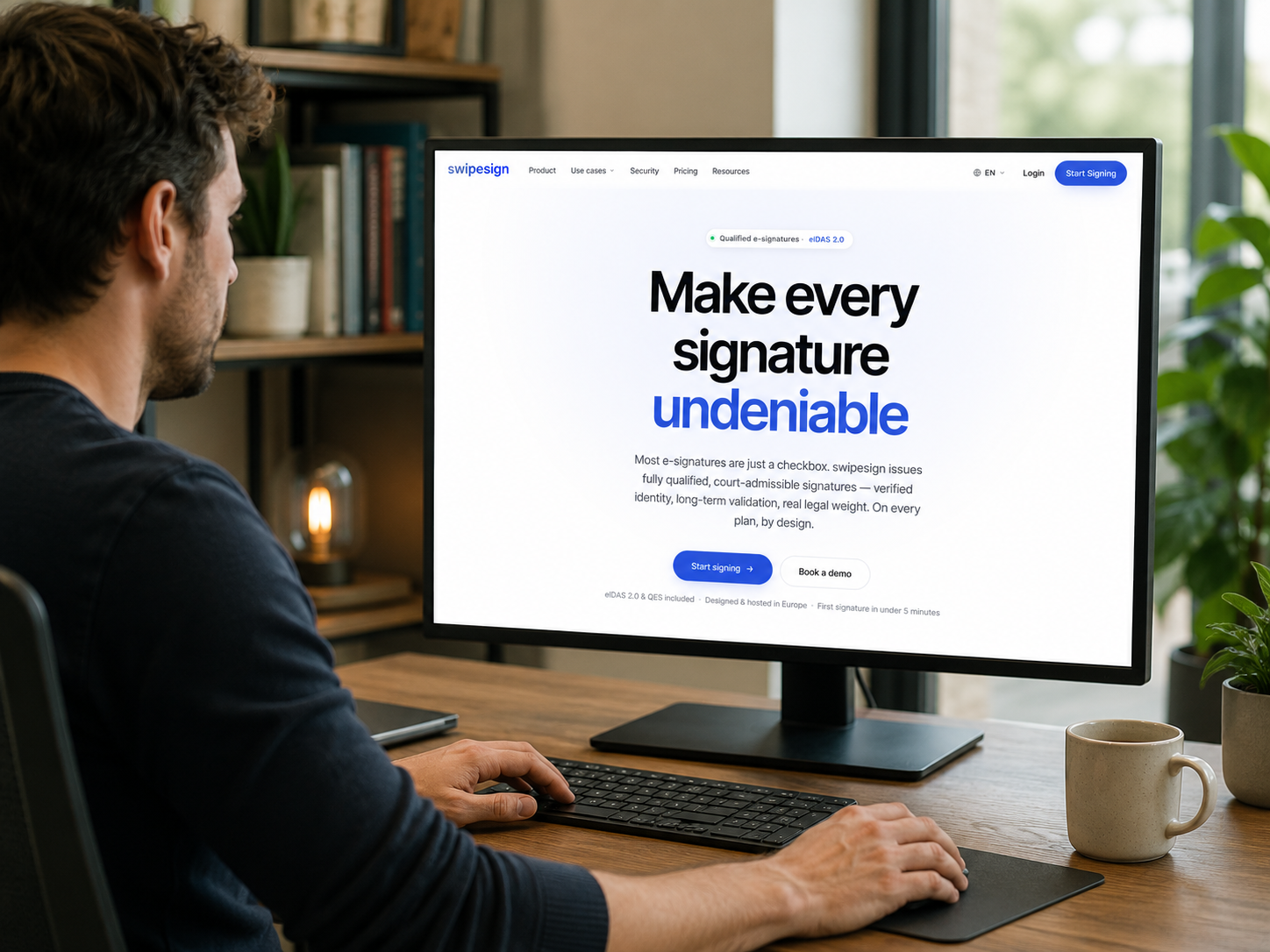
For swipesign, fast QES across Europe means giving signers a route that actually fits them. Instead of sending every cross-border signer into video identification, swipesign uses eID Easy to connect to trusted national eIDs through one integration, helping keep qualified signing fast, familiar, and built for more than one market.
Fast qualified signatures sound simple on paper.
But across Europe, the reality is a little more complicated.
A signer in Austria may use ID Austria. Someone in Belgium, Germany, Italy, or Spain may rely on a completely different national eID. These methods can carry the right assurance level, but they are not automatically interchangeable, and each one can mean another integration to build, maintain, and review.
For swipesign, that matters.
Their customers sign with counterparties, employees, and clients across multiple EU countries. So a signing flow that only works well in one jurisdiction is not enough. The experience has to stay fast, trusted, and familiar for signers across borders.
With eID Easy, swipesign can connect to a broad set of nationally notified EU eID and signature schemes through one integration point, while also using eSealing to add verifiable proof of integrity and origin to completed documents.
swipesign is built around one clear promise: fast, qualified electronic signatures for every signer, wherever they are based.
The challenge is that Europe’s eID landscape is fragmented by design. Under eIDAS, each member state notifies its own national eID scheme. A German eID, a Belgian eID card, and an Austrian ID Austria credential can all carry substantial or high assurance, but each still needs its own technical setup before a signer can actually use it.
For swipesign, this created two poor options.
They could build and maintain separate integrations for every national scheme they wanted to support. Or they could fall back to video identification for signers outside their supported set.
Neither option felt right.
Video identification is slower, more expensive per signer, and a heavier experience for someone who already has a recognised EU eID they use in daily life. For customers signing with people across Europe, that extra friction can quickly slow down legal and business workflows.
eID Easy gives swipesign a single integration point to a broad set of nationally notified EU eID and signature schemes.
That means signers can authenticate with an eID they already own and trust, at an assurance level that supports AdES and QES, instead of being routed by default into video identification.
This sits alongside swipesign’s existing identity stack, including ID Austria for Austrian residents, WebID for video identification, PXL Vision, and A-Trust on the qualified-certificate side.
Together, this gives swipesign more flexibility. The signer gets the verification route that fits their situation, instead of being pushed through a heavier process than necessary.
swipesign also uses eID Easy’s eSealing to apply qualified electronic seals to completed documents. This means a finished swipesign document carries verifiable proof of integrity and origin alongside the individual signatures.
For signers who already have a recognised national eID, the experience becomes much smoother.
No scheduling a live video call.
No waiting for an agent.
No extra steps when a trusted credential already exists.
For swipesign’s business customers, this helps remove a real friction point in cross-border legal and business transactions: proving the identity of a party in another EU member state without slowing down the whole process.
It also supports swipesign’s positioning as a genuinely pan-European signing platform, not a single-country tool.
Expected benefits include:
The figures shared by swipesign are projections based on their current flows and will be replaced with observed data once there is meaningful usage volume.
Based on those projections:
For a seven-person team, the partnership matters as much as the technology.
swipesign described the eID Easy team as genuinely approachable and quick to respond, even while scaling rapidly. Their team can raise practical problems openly, work through technical options together, and stay confident that the setup is properly aligned.
That kind of support matters when you are building something ambitious: a fast, borderless qualified signature service that works across Europe without making the signer experience heavier than it needs to be.
“Estonia and its tech industry has long set the benchmark for international e-signature infrastructure. Integrating eID Easy connects swipesign directly to that ecosystem: signing that is fast, built to the highest technical standards, and no longer tied to a single jurisdiction. It gives us the blueprint for a genuinely borderless qualified signature service.”
— Hannes Aigner, Founder, swipesign
With eID Easy, your business can focus on what really matters—expanding your reach and building trust with customers and partners worldwide.
.png)