Authentication & Secure Access (SCA)
One API integration for secure login and user authentication with trusted digital identities
Authenticate users with high assurance using bank and national eIDs, for login, step-up verification, and transaction approvals.
Replace passwords and one-time codes with methods users already trust, and prepare for EU Digital Identity Wallets (EUDIW) as they launch.
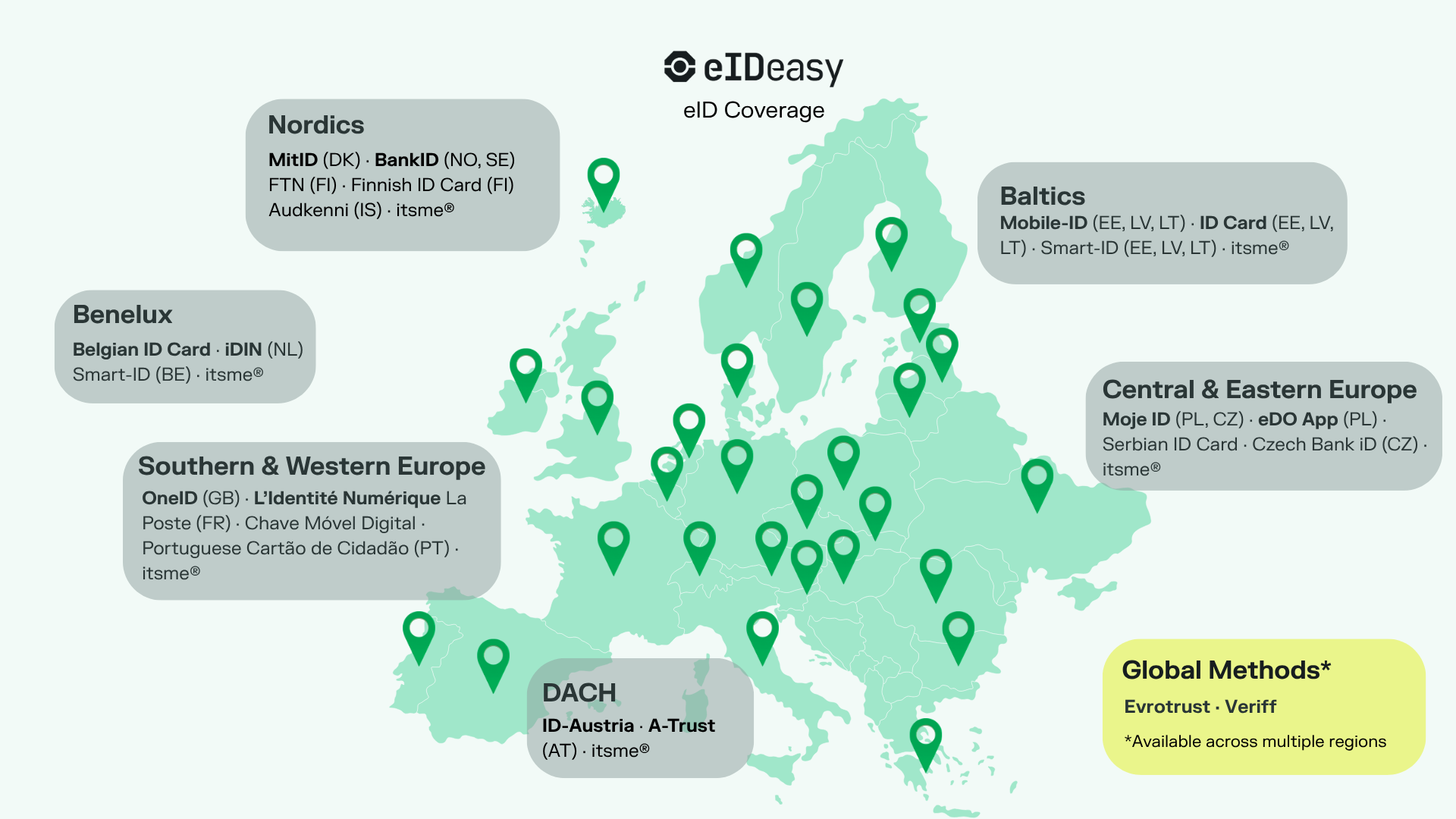
- Broad identity coverage
- One API integration
- Ready for EUDIW
A better way to authenticate users
Passwords, SMS codes, and app-based authentication add friction and don’t always provide strong identity assurance. Using trusted digital identities allows you to authenticate users securely, reduce fraud risk, and simplify the user experience.


The OLD WAY
Document-based identity verification
- Passwords and SMS codes
- Separate login and verification flows
- Repeated step-up checks

The EID Easy solution
Trusted digital identity via a single API
- Authentication using bank or national identity
- One trusted identity across authentication
- Strong, reusable authentication when needed
Stay compliant with leading global regulations

eIDAS Regulation
Support identity methods aligned with European standards for electronic identification and trust services, including high-assurance identity verification across the EU.

PSD2 Strong Customer Authentication (SCA)
Comply with payment security requirements. Protect users and transactions with multi-factor authentication.

GDPR and data residency rules
Safeguard personal data and privacy. Ensure identity data is processed in line with GDPR principles.

How identity authentication works with eID Easy
01.
User attempts to log in or perform a secure action
The user logs in, approves a transaction, or accesses sensitive data.
02.
User selects a trusted identity method
They choose a bank or national identity provider.
(Wallet-based identity methods can be added as they become available.)
03.
User confirms their identity
They authenticate using familiar steps in their banking or national ID app.
04.
Access is granted instantly
The user is securely authenticated and continues without passwords or codes.
Why choose eID Easy for authentication & secure access (SCA)

Wallet-ready authentication
Use eID authentication today and extend the same flows with European Digital Identity Wallets (EUDIW) as they become available.

Identity, signing, and sealing in one flow
Combine eID-based authentication with eSignatures and eSeals to support end-to-end, legally valid fintech workflows.

Broad eID provider coverage
Access a wide range of trusted national eID and bank-based identity providers.

Single unified API
Avoid integrating multiple identity providers market by market.

Lower friction, higher conversion
Replace document uploads with familiar identity methods users already trust, improving onboarding completion.
Authentication & Secure Access (SCA) & EUDIW - FAQ
How is this strong authentication different from traditional login methods?
Strong authentication confirms a user’s identity using multiple factors, such as something they know, have, or are. It is commonly required for sensitive actions and payments.
Traditional methods rely on passwords or codes. eID authentication uses trusted identity providers, offering higher assurance and better resistance to fraud.
Can eID authentication be used today, or is it only for EUDI Wallets?
eID authentication is widely used today with existing national and bank-based eID schemes. European Digital Identity Wallets (EUDIW) will extend this model, and fintechs can prepare now by using wallet-ready identity platforms, like eID Easy.
Is this compliant with SCA requirements?
Yes. Authentication using trusted identity providers can support Strong Customer Authentication (SCA) flows under PSD2.